Is YouTube Quietly Promoting AI Channels?
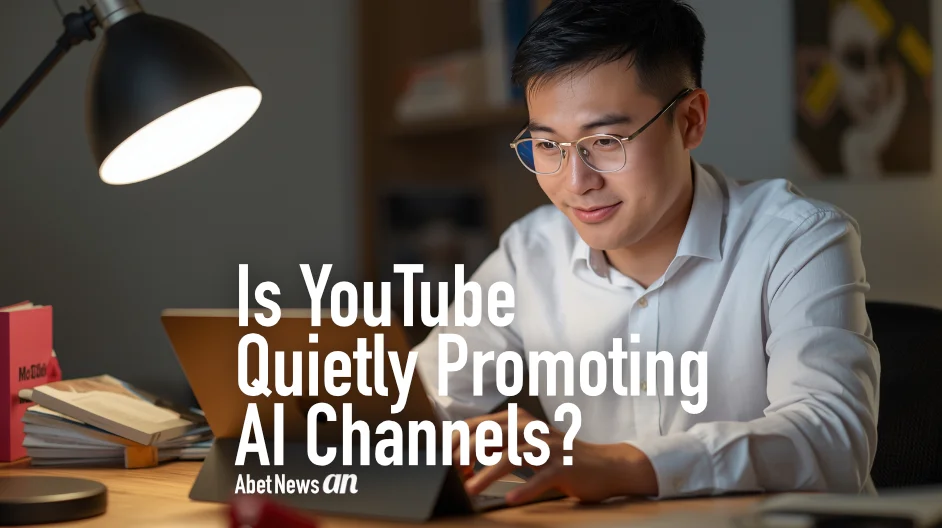
Viewers Say Control Is Disappearing
AI-generated YouTube channels are exploding — and users are starting to notice something unsettling.
From history explainers to “educational” mini-documentaries, a growing number of faceless channels are flooding recommendation feeds. They upload relentlessly, rack up suspicious engagement numbers, and in some cases, viewers say YouTube doesn’t even give them the option to stop seeing them.
This has led to a provocative question spreading across creator and viewer communities alike:
Is YouTube merely hosting AI-generated content — or actively shaping a platform where synthetic channels dominate?
The Rapid Rise of AI-Generated YouTube Channels
AI YouTube channels follow a recognizable pattern:
• Generic but safe evergreen topics
• AI-written scripts and synthetic narration
• Stock visuals or looping animations
• Emotionally neutral delivery
• Daily or even multiple uploads per day
Unlike human creators, these channels don’t need rest, inspiration, or lived experience. Entire videos can be produced in minutes and scaled across dozens of channels by a single operator.
From an algorithmic perspective, this content is highly efficient. From a cultural perspective, it’s raising serious questions.
“Don’t Recommend This Channel” — Why Is It Missing?
One of the biggest frustrations reported by users is the apparent loss of control over recommendations. While YouTube typically allows viewers to select “Don’t recommend this channel,” many claim this option appears inconsistently — or fails to meaningfully affect what the algorithm serves next, especially with AI-generated content.
Whether this is an intentional design decision or a byproduct of algorithmic optimization, the outcome feels the same to viewers:
• Reduced agency
• Repetitive AI content loops
• A sense that preferences no longer matter
The recommendation feed begins to feel less personalized — and more managed.
Suspicious Views, Subscribers, and Engagement
Another red flag frequently cited is engagement that doesn’t feel organic.
Common patterns include:
• Rapid subscriber growth without clear audience communities
• High view counts paired with shallow or repetitive comments
• Identical comment phrasing across unrelated videos
• Channels with near-identical formats operating at scale
None of this alone proves manipulation. But taken together, it fuels distrust in a system already criticized for opaque metrics and algorithmic favoritism.
Once artificial momentum is established, the recommendation engine often amplifies it further — regardless of authenticity.
Is YouTube Creating AI Channels?
There is no public evidence that YouTube is directly creating AI-generated channels.
However, critics argue that the distinction may be irrelevant.
By optimizing recommendations for:
• Upload frequency
• Watch-time efficiency
• Brand safety
• Predictable viewer behavior
…the platform effectively rewards automation over human creativity.
In this environment, AI channels don’t need special treatment to succeed. The system itself becomes the incentive.
Why AI Content Makes Sense for Platforms
From a business standpoint, AI-generated content offers clear advantages:
• Low production cost
• Infinite scalability
• No labor disputes or creator burnout
• Minimal reputational risk
• Seamless global localization
For platforms driven by engagement metrics, AI content is not a threat — it’s an asset.
For human creators, it’s a fundamentally uneven playing field.
The Cultural Cost of Synthetic Media
The concern goes beyond fairness or monetization.
Human creators bring:
• Perspective shaped by experience
• Emotional nuance
• Creative risk
• Imperfection and authenticity
AI-generated videos tend to prioritize neutrality, sameness, and frictionless consumption. Over time, this creates a platform filled with content that is technically informative but emotionally hollow.
Viewers may not consciously reject it — but they feel the absence of something human.
What This Means for Creators and Viewers
As AI-generated content becomes indistinguishable from human-made videos, transparency becomes critical. Without clear labeling, consistent recommendation controls, and meaningful feedback mechanisms, trust in the platform erodes.
For creators, success increasingly depends on production velocity rather than originality — a shift that disproportionately benefits automation.
For viewers, YouTube risks becoming less of a community and more of an automated content supply chain.
A Platform at a Crossroads
AI is not inherently the problem. Automation has always shaped media.
The real issue is who controls the experience — and whether users still have meaningful choice.
If YouTube continues down a path where synthetic content is protected, amplified, and difficult to escape, the platform may quietly transform from a space of human expression into a machine optimized to talk to itself.
And once that shift becomes normalized, it’s very hard to reverse.
Andy Young
Abet News | February 9, 2026
Related Posts


Apple TV+
JMI Construction