Apple’s Quiet AI Strategy
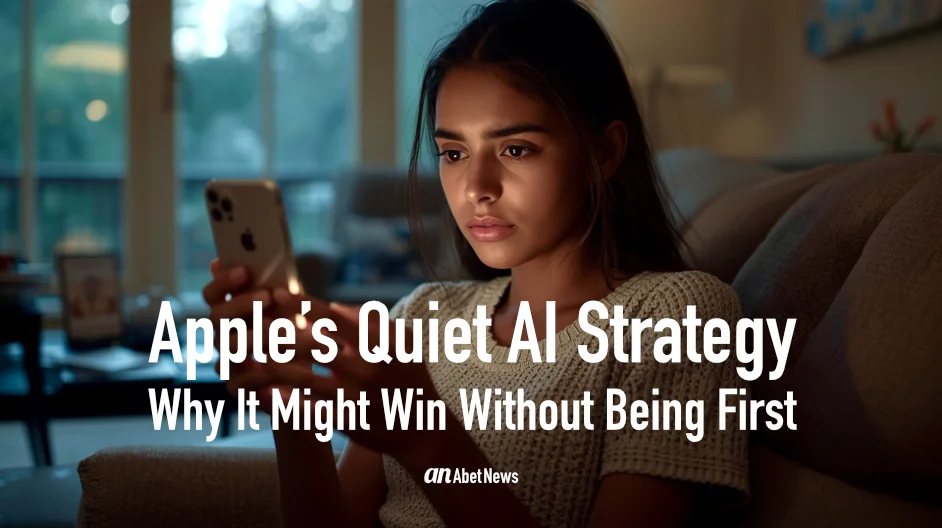
Why It Might Win Without Being First
Abet News · March 25, 2026
In today’s artificial intelligence boom, speed has become synonymous with success. Tech giants are racing to build larger models, faster systems, and more attention-grabbing demonstrations. Yet amid the noise, Apple Inc. is moving differently—more quietly, more deliberately, and perhaps more strategically.
While competitors chase scale, Apple is focused on something far less flashy: usefulness.
A Different Definition of Intelligence
For Apple, AI is not about spectacle—it’s about subtlety. Instead of positioning artificial intelligence as a standalone product, the company embeds it into everyday experiences. From predictive typing to advanced photography and health tracking, Apple’s AI operates behind the scenes, enhancing rather than interrupting.
This approach signals a shift in philosophy. The goal is not to impress users with what AI can do, but to integrate it so seamlessly that it becomes invisible—yet indispensable.
Privacy as Power
One of Apple’s most defining advantages in the AI era may be the very thing others struggle with: trust.
As concerns mount over data privacy and surveillance, Apple’s commitment to on-device processing stands out. By keeping data on the user’s device whenever possible, Apple minimizes exposure and maximizes control. In contrast to cloud-heavy AI models, this approach offers a compelling alternative—intelligence without intrusion.
In a world increasingly wary of how personal data is used, privacy is no longer just a feature. It is a competitive edge.
The Ecosystem Advantage
Apple’s strength has always been its ecosystem, and AI only amplifies this advantage.
With billions of active devices worldwide, Apple has the infrastructure to deploy AI at scale instantly. More importantly, it can create continuity—AI that understands context across devices, from iPhone to Mac to Apple Watch. This interconnected experience transforms AI from a tool into a cohesive, personalized assistant.
It’s not just about having AI. It’s about having AI that knows you—securely and seamlessly.
History Repeating Itself
Apple’s current position in AI feels familiar. The company was not first to smartphones, tablets, or wearables. Yet in each case, it redefined the category by refining the experience and focusing on usability.
The same pattern may now be unfolding.
Rather than leading the initial wave of AI innovation, Apple is positioning itself to refine it—turning complexity into clarity, and capability into everyday value.

The Real Question
The conversation around AI leadership often centers on who is ahead today. But Apple is playing a longer game.
The real question is not who builds the most powerful AI—but who builds the most trusted, human-centered, and widely adopted intelligence.
If Apple succeeds, it won’t be because it moved the fastest.
It will be because it moved the smartest.
Petra Lugar
© 2026 Abet News. All rights reserved.
Related Posts



Apple TV+
JMI Construction