
Apple Did It Again: Not First, But Better
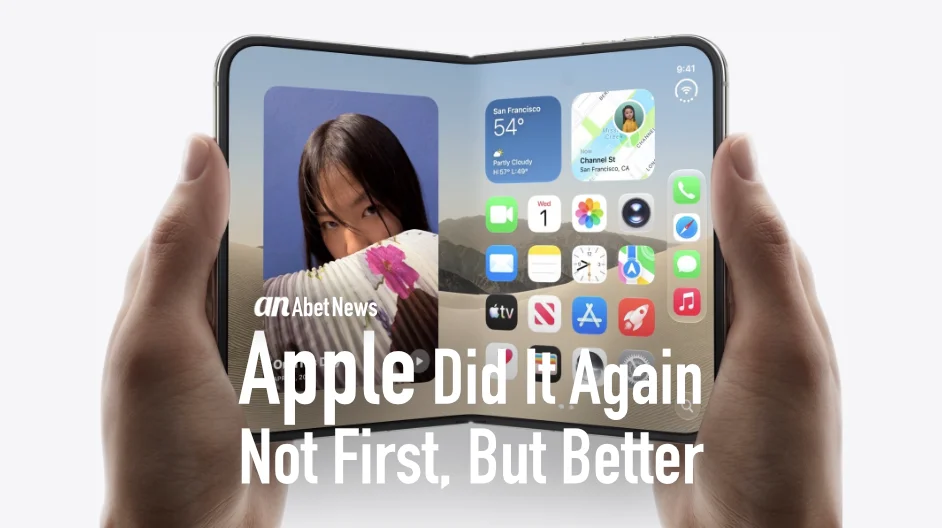
Apple’s new iPhone Duo may be the perfect example of why being first isn’t always the same as being best.
ABET NEWS | TECH NEWS | SEPTEMBER 9, 2026
There was something almost symbolic about Apple’s September 9 event.
A new CEO stood on the Apple stage for the first time.
Tim Cook’s era had formally come to an end, with Cook moving into the role of executive chairman and John Ternus taking over as CEO on September 1. Apple had already announced the transition months ago, but today’s event made it real.
And Apple didn’t simply pass the baton.
It passed it into the AI era.
A Different Kind of Apple Introduction
The opening was particularly interesting because Apple used artificial intelligence to frame the transition and the company’s next chapter.
Ternus’ message was remarkably clear: if we imagine the ideal AI device, it needs to understand our personal context, be with us everywhere, have powerful processors capable of running AI, connect to the cloud when necessary, have excellent cameras and microphones, offer a large display, provide long battery life, and remain simple to use.
Then came the obvious conclusion:
That device is already the iPhone.
Ternus also emphasized one of Apple’s most important differentiators in the AI race—privacy. Apple says Apple Intelligence runs on-device whenever possible rather than treating a user’s personal data as something to collect and store.
That was more than an AI demonstration.
It was a statement of strategy.
Apple isn’t necessarily trying to invent an entirely new category of AI hardware.
It appears to be asking a different question:
What happens when the device people already carry becomes the intelligent personal hub?
And then Apple introduced the product that may make that idea considerably more interesting.
Enter iPhone Duo
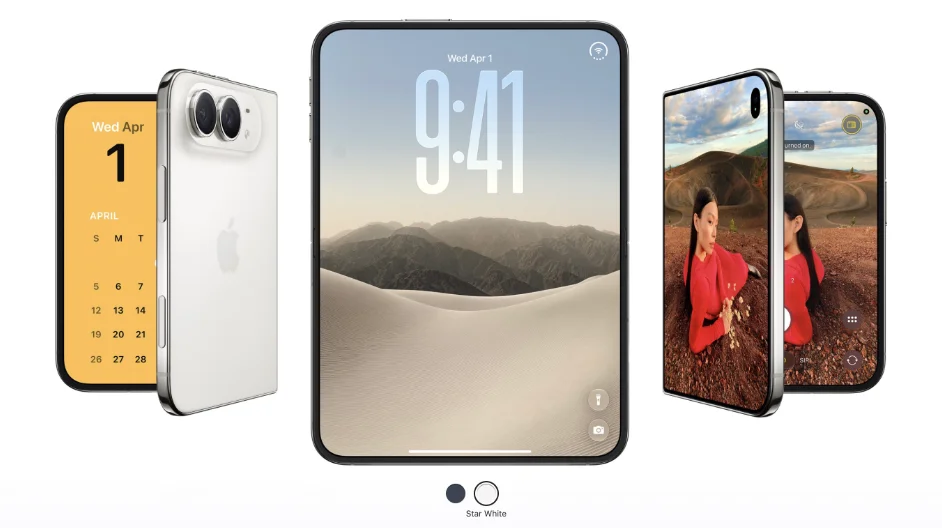
Meet the iPhone Duo.
Apple’s first foldable iPhone.
And this is where the old Apple philosophy becomes impossible to ignore.
Samsung has been making foldable phones for years. Google, Motorola, Huawei, Xiaomi and others have already explored the category.
Apple waited.
For some people, that will always be the criticism:
Apple wasn’t first.
Correct.
But perhaps that misses the point.
Apple has rarely built its reputation around being first.
It has built its reputation around taking an existing idea and asking whether it can make the experience simpler, more polished, more integrated and more desirable.
The original iPhone wasn’t the first smartphone.
The Apple Watch wasn’t the first smartwatch.
AirPods weren’t the first wireless earbuds.
The iPad wasn’t the first tablet.
And now the iPhone Duo isn’t the first foldable phone.
That’s the pattern.
Let them do it first.
Then Apple enters the room.
Seven Years of Waiting May Have Been the Point
Apple’s foldable story has reportedly been years in the making, while competitors have had multiple generations to experiment with hinges, displays, software, battery life and durability.
That matters.
Foldable phones have spent years teaching the industry what consumers actually care about—and what they don’t.
Today’s iPhone Duo suggests Apple has been watching.
The result is a design that looks less like an experimental phone and more like an iPhone that happens to fold.
When closed, Duo has a 5.4-inch outer display and a compact, passport-like form.
Open it, and the device becomes a 7.6-inch display—the largest display ever placed on an iPhone and 50 percent larger than the iPhone 18 Pro Max display. Both displays use the same aspect ratio, allowing content to transition between the two forms more naturally.
That is an important distinction.
Apple isn’t simply selling the ability to fold a screen.
It is selling two ways of using an iPhone.
The Hardware Is Only Half the Story
This may ultimately be where Apple has its biggest advantage.
The fold itself isn’t revolutionary anymore.
The integration might be.
Apple has redesigned iOS 27 around the Duo’s different orientations and screen sizes, including multitasking and interfaces that adapt as the phone opens and closes.
That’s the Apple advantage at its best:
Hardware + software + silicon + services + ecosystem.
The company controls all of those pieces.
The Duo also brings Apple’s A20 Pro chip, a custom vapor chamber thermal system, a dual-battery architecture, ProMotion displays, Always-On functionality and up to 3,000 nits of peak outdoor brightness. (iPhone Duo)
And Apple didn’t stop at making the screen fold.
It found new reasons for the folding design to matter.
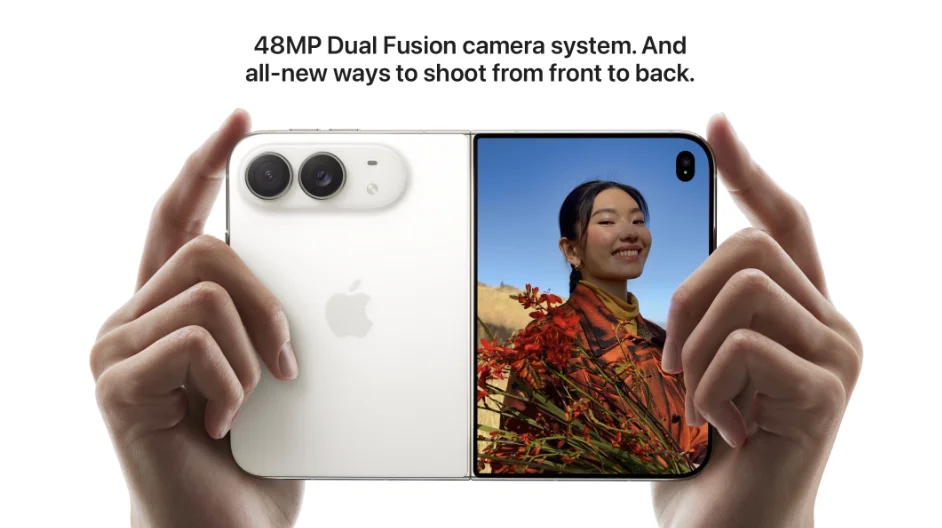
The camera system can use the outer display as a preview, allowing users to take higher-quality selfies with the rear cameras. FaceTime can use both sides of the device in ways that aren’t possible on a conventional iPhone. Apple is also using on-device AI for features such as Smart Take, which can recognize when people are ready for a photograph and automatically capture the moment.
Those are the details worth watching.
Because this is where a specification becomes an experience.
A New CEO. A New Era. A Familiar Apple.
There is another layer to today’s announcement that may ultimately prove more important than the Duo itself.
For the first time in 15 years, Tim Cook wasn’t leading Apple’s iPhone launch as CEO.
John Ternus was.
Cook’s legacy is enormous. He took over after Steve Jobs and guided Apple through an extraordinary period of growth, expanding the company’s product ecosystem and turning services into a major part of Apple’s business.
Today, he passed the baton.
And Ternus immediately walked onto the biggest stage Apple has.
The symbolism is hard to miss.
A new CEO.
A new generation of iPhone.
A major step into foldable computing.
And an Apple increasingly defining its future around artificial intelligence.
That’s quite a first day.

Some things cannot be automated. A kind word. A warm embrace. A healing touch.
Effusion – Healing Touch Remix, featuring Tamar (Clean)
Our First Take
The iPhone Duo looks promising. Very promising.
But perhaps the bigger story isn’t the fold.
It’s Apple’s timing.
Apple didn’t need to be first.
It needed to arrive with a product that felt mature enough to belong in the iPhone family.
Based on what Apple showed today, the Duo may have accomplished exactly that.
We will reserve the final verdict until we actually get our hands on one.
But if Apple can deliver the experience it demonstrated today, the iPhone Duo could become much more than Apple’s first foldable.
It could become the device that finally makes foldable phones feel normal.
And that is where Apple’s “not first, but better” philosophy becomes particularly interesting.
Let everyone else build the future first.
Apple will decide when the future is ready for the iPhone.
Andy Young
© 2026 Abet News. All rights reserved.
Related Posts








6 comments on Apple Did It Again: Not First, But Better
The opening and closing effect is so beautiful, I want it 😊
Should I buy it or wait for the update? what will it be called Duo 28? 😊
Hopefully, the new Siri and AI features in iOS27 will be good. Excited to see how it compares with Android 17.
I’m on team Duo, and looking forward to iOS27 September 14👍
I guess the iPhone Duo will be in the same category as the Vision Pro.
I don’t think Apple intends to sell too many iPhone Duos, as it’s hard to justify the $1,999 starting price.