The $300 Million Question: Could American Artists Lose Overseas Royalties?
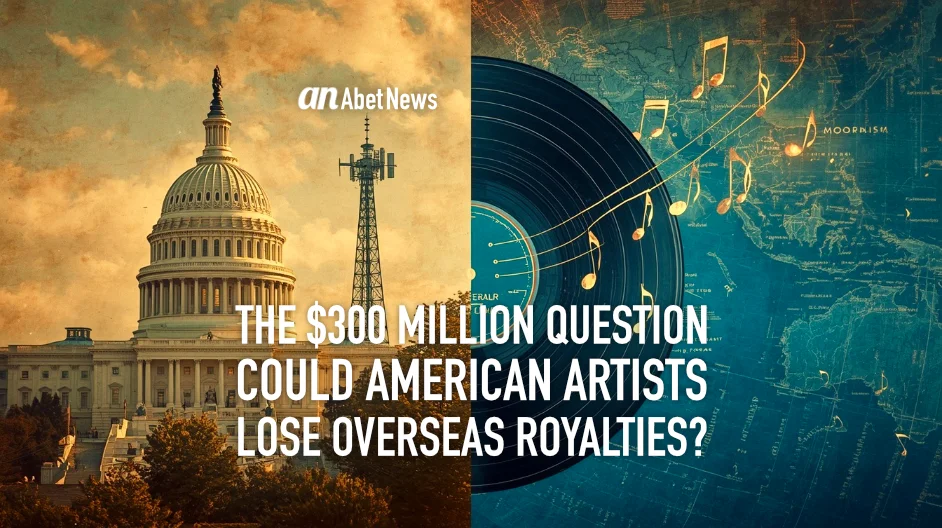
The debate isn’t just about $300 million—it’s about whether copyright protections should be reciprocal in a global music economy.
ABET NEWS · MUSIC INDUSTRY NEWS · JULY 28, 2026
For decades, American music has crossed borders more easily than almost any other cultural export. Songs recorded in Los Angeles, Nashville, New York, or Miami are streamed, broadcast, and performed in nearly every corner of the world. Yet behind every international radio broadcast lies a complicated web of copyright law—one that could soon cost American performers hundreds of millions of dollars.
Earlier this month, SoundExchange joined a coalition of leading music organizations representing artists, musicians, record labels, and music businesses in urging the Office of the United States Trade Representative to oppose a proposal under consideration in the European Union. According to the organizations, the proposal could place nearly $300 million in annual neighboring rights royalties earned by American performers at risk.
The warning has attracted support from more than fifty artists, including Gene Simmons, MC Lyte, Aerosmith, Barbra Streisand, Céline Dion, and Smokey Robinson, who have also urged Congress to pass the American Music Fairness Act.
At first glance, the issue appears straightforward: American artists should be paid when their recordings are played overseas. Most people would agree with that principle.
The reality, however, is far more complex.
Understanding Neighboring Rights
Most music fans know that songwriters earn royalties when their compositions are performed publicly. Fewer realize that performers and record labels may also receive compensation through what are known internationally as neighboring rights.
Neighboring rights compensate the performers who brought a recording to life and the companies that invested in producing it. In many countries, when a recording is broadcast on terrestrial radio or publicly performed, performers and record labels receive royalties in addition to songwriters.
For thousands of musicians, these payments provide meaningful income long after a recording has been released.
The American Exception
The United States stands apart from much of the developed world.
While American songwriters receive royalties when songs are played on AM/FM radio, performers and owners of the sound recordings generally do not receive comparable compensation from terrestrial radio broadcasts.
This longstanding exemption dates back nearly a century and has often been defended by broadcasters, who argue that radio provides artists with valuable promotion and exposure.
Critics counter that exposure does not pay studio bills, touring expenses, or the cost of making professional recordings. They argue that performers deserve compensation whenever their recordings generate value for broadcasters.
This disagreement has become one of the most debated issues in modern music policy.
Why Europe Is Paying Attention
The current dispute is rooted in a principle known as reciprocity.
Many countries recognize neighboring rights on the understanding that creators from other nations will receive comparable treatment.
European policymakers have increasingly questioned whether American performers should continue receiving full neighboring-rights payments abroad while the United States does not provide equivalent rights to performers whose recordings are played on American terrestrial radio.
Supporters of the European proposal argue that international copyright systems should operate on balanced, reciprocal protections.
American music organizations see the situation differently.
They argue that overseas royalties belong to the artists who earned them and should not become leverage in broader copyright negotiations.
Regardless of which perspective one favors, the debate illustrates how copyright law and international trade policy have become deeply interconnected.

Some things cannot be automated. A kind word. A warm embrace. A healing touch.
Effusion – Healing Touch Remix, featuring Tamar (Clean)
Why the American Music Fairness Act Matters
Supporters of the American Music Fairness Act believe the legislation could significantly strengthen the United States’ position.
If enacted, the bill would require AM/FM radio broadcasters to compensate performers and sound recording copyright owners when recordings are played over terrestrial radio—bringing the United States closer to the practices followed in many other countries.
Advocates argue the legislation would:
• Modernize American copyright law.
• Provide new income opportunities for performers.
• Improve international reciprocity.
• Help protect neighboring-rights revenue earned overseas.
Broadcasters, however, continue to oppose the proposal.
Many argue that local radio stations already serve as an essential promotional platform for artists and that additional royalty obligations could place financial pressure on smaller community broadcasters operating with limited budgets.
The debate reflects a familiar challenge in the music business: balancing fair compensation for creators with the economic realities faced by those who distribute their work.
Beyond $300 Million
While headlines understandably focus on the estimated $300 million in neighboring-rights income, the larger question extends well beyond a single number.
Music has become global.
A song recorded in California can be streamed in France, broadcast in Germany, remixed in Brazil, and discovered in Japan within hours of its release.
Yet copyright laws remain largely national, shaped by different legal traditions and policy priorities.
As the music industry grows increasingly international, these differences create friction. Governments negotiate. Trade officials intervene. Artists become caught between competing legal systems.
This dispute is one example of a much broader conversation about how creators should be compensated in a digital, borderless marketplace.
Looking Ahead
Whether Congress passes the American Music Fairness Act or European policymakers ultimately move forward with their proposal, one fact is becoming increasingly clear: copyright reciprocity is no longer an abstract legal concept reserved for attorneys and trade negotiators.
It has become a practical issue affecting the livelihoods of performers, independent musicians, record labels, and music businesses around the world.
The outcome of today’s policy decisions could influence how creators are compensated for decades to come.
As governments seek to modernize copyright law for a global music economy, one question remains at the center of the debate:
If artists deserve to be paid wherever their music is heard, how should nations work together to make that principle a reality?
That is a conversation worth having—not only in Washington and Brussels, but throughout the global music community.
Amy H.
© 2026 Abet News. All rights reserved.
Related Posts




#AbetNews, #AmericanArtists, #AmericanMusicFairnessAct, #AmyH, #Article, #EU, #EUNeighboringRights, #EUTechPolicy, #Industry, #IndustryImpact, #InternationalMusicRoyalties, #MusicCopyright, #MusicIndustry, #MusicIndustryNews, #MusicLicensing, #MusicRoyalties, #NeighboringRights, #OverseasRoyalties, #PerformanceRoyalties, #Royalties, #SoundExchange
Apple TV+
JMI Construction