Europe Regulates Big Tech — and Then Finances It
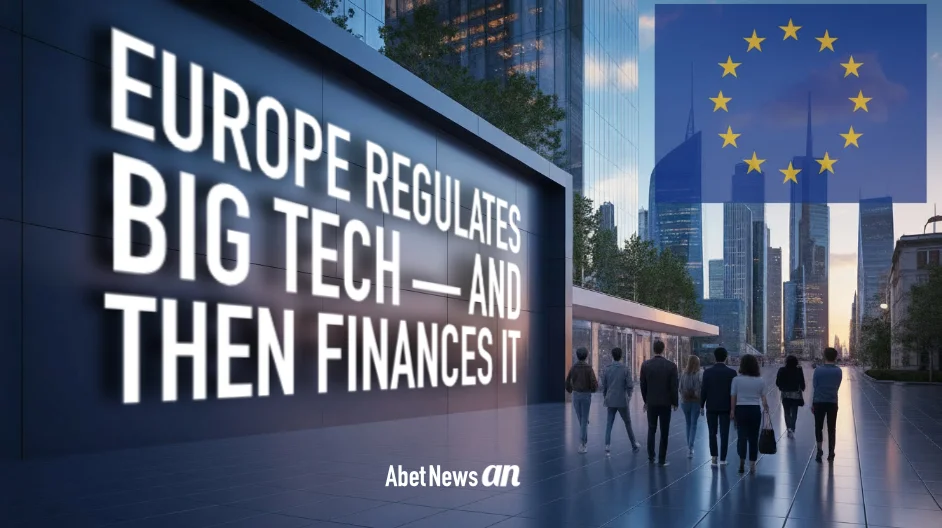
Alphabet is facing more than €12 billion in potential damages from dozens of European price‑comparison websites, all piggybacking on earlier EU antitrust rulings that found Google abused its dominance in search. It is one of the largest waves of follow‑on litigation the bloc has ever seen.
And yet, almost simultaneously, Europe became one of Alphabet’s most enthusiastic creditors.
The company’s blockbuster sterling bond issuance — including a rare 100‑year tranche — drew roughly £30 billion in demand from European pension funds, insurers, and investment‑grade credit managers. A market that only months ago was considered sluggish suddenly became the preferred venue for financing one of the world’s most powerful technology companies.
The juxtaposition is striking. Europe is suing Alphabet with one hand and buying its debt with the other. But the contradiction is only superficial. In reality, it reveals something essential about the structure of Europe’s economy — and its relationship to the American tech giants it cannot domestically replicate.
Regulation and financing operate on different logics
Europe’s regulatory posture toward Big Tech is rooted in sovereignty, competition, and consumer protection. The EU wants to constrain platform dominance, enforce antitrust rules, and shape the governance of digital markets. Alphabet’s legal exposure is a direct expression of that ambition.
But Europe’s financial system has its own imperatives. Pension funds and insurers carry liabilities stretching decades into the future. They need long‑duration, high‑quality assets — and Europe does not produce enough of them. Domestic corporates rarely issue 30‑, 50‑, or 100‑year bonds. Sovereign issuance is limited. Growth is modest.
US megacaps, by contrast, offer pristine balance sheets, global revenue, and maturities that match Europe’s long‑term obligations. Alphabet’s century bond wasn’t a novelty; it was a solution.
Regulation is about power.
Investment is about returns.
Europe can dislike Alphabet’s market behavior and still love Alphabet’s credit profile.
Europe needs hyperscalers more than hyperscalers need Europe
This is the uncomfortable truth beneath the irony. Europe’s capital markets are deep, but its corporate sector is not. The continent has no hyperscalers, no global cloud platforms, no GPU manufacturers, and no AI infrastructure giants. It regulates the tech economy but depends on foreign firms to supply the assets its financial system requires.
Alphabet’s sterling deal made that dependence visible. European institutions — the same ones whose governments are pursuing Alphabet in court — lined up to buy a 100‑year claim on the company’s future cash flows. They did so because they had to. Duration‑matching is not optional.
The irony is structural, not accidental
Europe is simultaneously:
• the world’s most aggressive regulator of US tech
• one of the largest investors in US tech
• and now a major financier of US tech’s AI infrastructure build‑out
This dual role is not hypocrisy. It is the architecture of a continent that has chosen to govern the digital economy without building its own global champions.
Alphabet’s legal liabilities and Alphabet’s sterling bond success are not opposing stories. They are two sides of the same European strategy: discipline the platforms, but rely on them; constrain their power, but underwrite their expansion; regulate their dominance, but invest in their longevity.

A new kind of interdependence
The result is a paradox that will define the next decade of European economic policy. Europe is becoming both the watchdog and the banker of the AI future — regulating the companies it cannot replace, and financing the companies it cannot afford to lose.
Alphabet’s legal battles may cost billions. Its bond issuance raised billions more. And Europe is on both sides of the ledger.
David Frein
Abet News | February 11, 2026
Related Posts




Apple TV+

JMI Construction