The Sanctions Don’t Work Anymore — Huawei’s Chip Breakthrough Explained
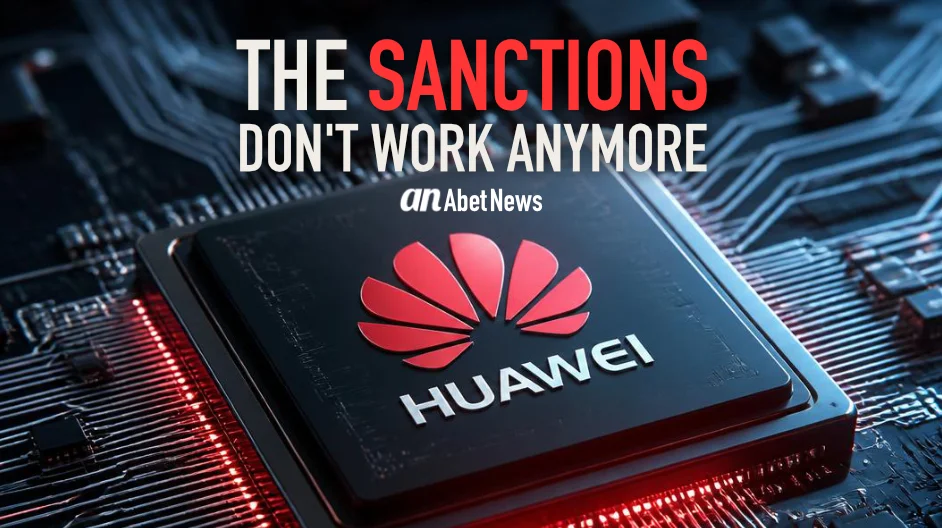
Huawei just announced it can build 1.4-nanometer chips without ASML’s machines, without TSMC’s fabs, and without Washington’s permission. The Western export control architecture has a crack in it — and China is prying it open.
ABET NEWS · TECH IN WAR · MAY 26, 2026
For five years, the United States has operated on a single strategic assumption: if you cut China off from the machines that make advanced chips, you cut China off from the future of AI. That assumption may no longer hold.
On Monday, Huawei semiconductor chief He Tingbo stepped onto a stage in China and delivered what might be the most consequential technology announcement of the decade — not because the claims are proven, but because of what they imply. Huawei, the company Washington has spent half a decade trying to strangle, says it has found a way around the wall.
The announcement centers on a new chip architecture called LogicFolding, governed by what Huawei is calling the Tau Scaling Law — or, as Chinese social media has already dubbed it, “Her’s Law,” in recognition of He Tingbo’s gender and the novelty of the claim. The core thesis is as audacious as it is simple: stop trying to shrink transistors, and start accelerating how fast signals move between them. Measure progress not in nanometers, but in tau — the time constant for signal propagation across a circuit.
“We saw that time scaling can deliver strong benefits across devices, circuits, chips, and systems.”
— He Tingbo, Huawei Semiconductor Chief, May 25, 2026
The strategic context is everything. ASML’s extreme ultraviolet lithography machines — the Dutch equipment that makes sub-5nm chip production possible — are the single chokepoint on which Western export controls depend. Every chip restriction, every entity list addition, every allied coordination with the Netherlands and Japan has been built around one premise: that you cannot make cutting-edge semiconductors without EUV. Huawei is now claiming that premise is obsolete.
A Three-Year Gap, Not Five
Today, the gap between what TSMC can produce and what Huawei can produce — manufacturing through its domestic partner SMIC — is approximately five years. TSMC is already producing advanced 3nm chips at scale. Huawei and SMIC are operating on a roughly 7nm-class node, constrained by older deep ultraviolet lithography equipment they were permitted to acquire before the sanctions tightened.
The Huawei claim, if true, compresses that gap to three years by 2031. The company says LogicFolding-based chips will reach 1.4nm-equivalent performance by that date. TSMC has scheduled actual 1.4nm mass production for 2028. The gap narrows from five years to three — not closed, but dramatically different in strategic terms. A three-year lag is a competitive disadvantage. A five-to-seven-year lag is irrelevance.
The Kirin chips scheduled for release in Fall 2026 will be the first to carry the LogicFolding architecture — a real-world test of whether the claims survive contact with production reality.
What Washington Built, and What It Missed
The Biden-era chip controls — extended and sharpened by the Trump administration — were designed to freeze China’s semiconductor capability in place. By blocking access to EUV machines, advanced chip design software, and the engineers who understand both, the strategy aimed to impose a permanent ceiling on Chinese AI hardware. The logic was airtight, because it was built on a monopoly: no one else makes EUV machines. ASML is the only company on the planet that can.
What the strategy didn’t account for was the possibility that China might render EUV irrelevant. Huawei’s Tau Scaling Law doesn’t try to replicate what TSMC does. It proposes a different definition of progress entirely — one that doesn’t require the machine Washington spent years weaponizing.
That’s not a workaround. That’s a paradigm shift.
The Credibility Problem
None of this is independently verified. Every figure Huawei has released — including a claimed 53.5% transistor density gain for the Kirin 2026 — is first-party data. No third-party auditor has examined the chips. No external benchmarks exist. The semiconductor industry has seen Chinese companies make extraordinary claims before that crumbled under scrutiny.
But here’s what makes this moment different: Huawei has a track record. The company’s Kirin 9000s chip, quietly fabbed by SMIC on a 7nm-class process in 2023, shocked analysts who had assumed sanctions had made that impossible. The announcement of that chip — buried in a Huawei smartphone launch — landed like a strategic earthquake. Washington tightened controls further in response.
Dismiss Huawei’s claims at your peril. They’ve been right before when everyone assumed they couldn’t be.
The AI Weapons Dimension
The stakes aren’t abstract. Advanced chips at the 1.4nm class are not consumer electronics — they are the substrate of AI at scale. They power the training of frontier models, the inference engines behind autonomous systems, and the processing cores of next-generation military hardware. The US has explicitly framed its chip export controls as a national security measure precisely because of this link.
If Huawei closes the gap to three years — or less, if the technology matures faster than projected — China’s AI military capability accelerates on a timeline Western defense planners have not modeled. The assumption embedded in every Pentagon AI roadmap is that the hardware gap is durable. That assumption is now in question.
Washington built a wall out of silicon and Dutch machinery. Huawei may have just found a door.
Andy Young
© 2026 Abet News. All rights reserved.
Related Posts



Apple TV+

JMI Construction