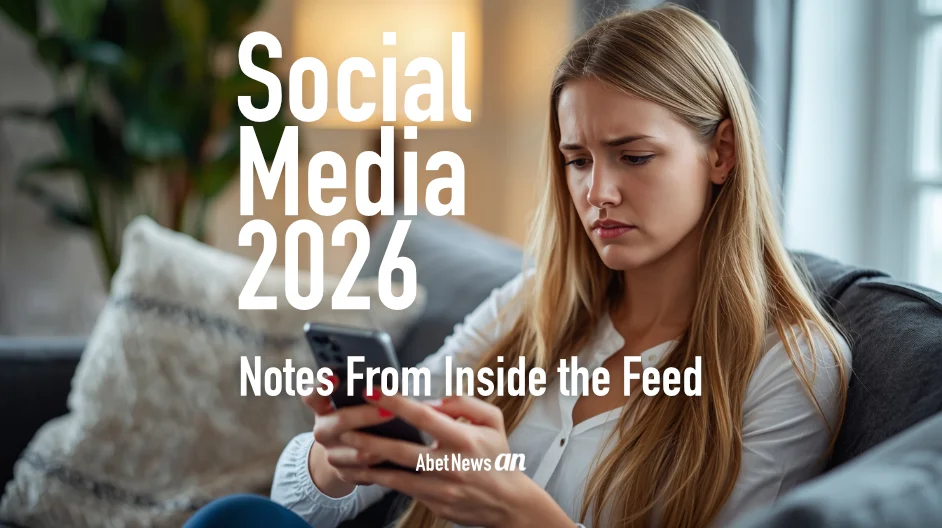
Social Media 2026: Notes From Inside the Feed
I. The Year the Algorithms Stopped Pretending
By 2026, the feed no longer feels like a mirror — it feels like a room with one‑way glass.
You speak, but the platforms decide which words echo and which ones dissolve before they reach anyone else.
TikTok, once the chaotic global commons, now moves with a new stiffness.
Ever since the U.S. forced its restructuring and Oracle stepped in, users have been whispering the same thing: the tone changed. Not in a dramatic purge, but in a subtle, ambient shift — the kind you only notice if you’ve lived online long enough to sense when the wind changes direction.
People report posts disappearing when they criticize certain political ideologies. Mentions of controversial figures seem to vanish into the algorithmic void. And the “For You” page, once a wild, unpredictable river, now feels curated with a heavier hand.
The companies deny intentional censorship.
But the experience of millions tells a different story.
In 2026, perception is reality — because perception is all the platforms allow us to see.
II. Meta’s New Filters and the Words That Don’t Exist
Meta’s new “Topics” feature was supposed to give users more control.
A way to tell the algorithm: show me more of this, less of that.
But when people tried to select topics like “Palestine,” “Gaza,” “Middle East,” they found… nothing.
The words simply weren’t there.
You could choose “K‑pop,” “home organization,” “astrology,” “minimalist kitchens,” even “quantum computing.”
But not the geopolitical terms dominating global headlines.
Meta says it’s about reducing “sensitive political content.”
But to users, it feels like something else:
a quiet narrowing of the public vocabulary.
If you can’t name a thing, you can’t follow it.
If you can’t follow it, you can’t understand it.
And if you can’t understand it, you can’t challenge it.
In 2026, the algorithm doesn’t just shape your feed — it shapes your language.
III. The New Censorship Isn’t Loud — It’s Silent
The censorship of the 2020s wasn’t the old kind.
No bans, no warnings, no dramatic takedowns.
Instead, it’s:
• throttled reach
• invisible shadowbans
• missing hashtags
• posts that never leave “review”
• videos that get 0 views for hours
• topics that mysteriously don’t autocomplete
• feeds that tilt toward certain narratives without ever admitting it
It’s not a wall — it’s fog.
You don’t hit a barrier.
You just lose your sense of direction.
IV. Ownership, Influence, and the Invisible Hand
Platforms insist their moderation is neutral.
But in 2026, neutrality is a myth.
TikTok’s U.S. infrastructure is now controlled by a corporation whose leadership has well‑documented political alliances.
Meta’s moderation systems have a long history of over‑filtering certain regions and languages.
YouTube’s recommendation engine still quietly nudges viewers toward “safe” advertiser‑friendly content.
None of this requires conspiracy.
It only requires incentives.
And incentives, in 2026, are geopolitical.
V. What It Feels Like to Live Inside the Machine
For the everyday user, the experience is simple:
You open your apps and feel like the world is shrinking.
Not because there’s less happening — but because less is being shown to you.
You try to follow a conflict, and the platform decides it’s “sensitive.”
You try to talk about a political figure, and your post gets zero traction.
You try to curate your own feed, and the topics you care about aren’t available.
You start to wonder: Is this my feed, or their feed?
Is this my voice, or their filter?
By 2026, social media doesn’t feel like a public square.
It feels like a museum exhibit — curated, sanitized, and supervised.
VI. The Observer’s Conclusion
Social media in 2026 is not collapsing.
It’s evolving — into something quieter, more controlled, more “managed.”
Platforms claim it’s about safety.
Governments claim it’s about national security.
Corporations claim it’s about user experience.
But from inside the feed, it feels like something else:
A slow, subtle re‑drawing of the boundaries of what can be seen, said, or shared.
Not censorship by force.
Censorship by architecture.
And the most unsettling part?
Most users won’t notice.
Not because they’re unaware —
but because the platforms have removed the very words they would need to describe what’s happening.
Amy H.
Abet News | January 30, 2026
Related Posts



#AbetNews, #Algorithm, #AlgorithmicCensorship, #AmyH, #Article, #Censorship, #DigitalRights, #DigitalRights2026, #Facebook, #Industry, #IndustryImpact, #Meta, #MetaTopicsFeature, #OnlineWorld, #Oracle, #SocialMedia, #SocialMedia2026, #Tech, #TechIndustry, #TechNews, #Technology, #TikTok, #TikTokAlgorithm, #TrustInTech, #UserFeedback
Apple TV+
JMI Construction