The First AI War Explained
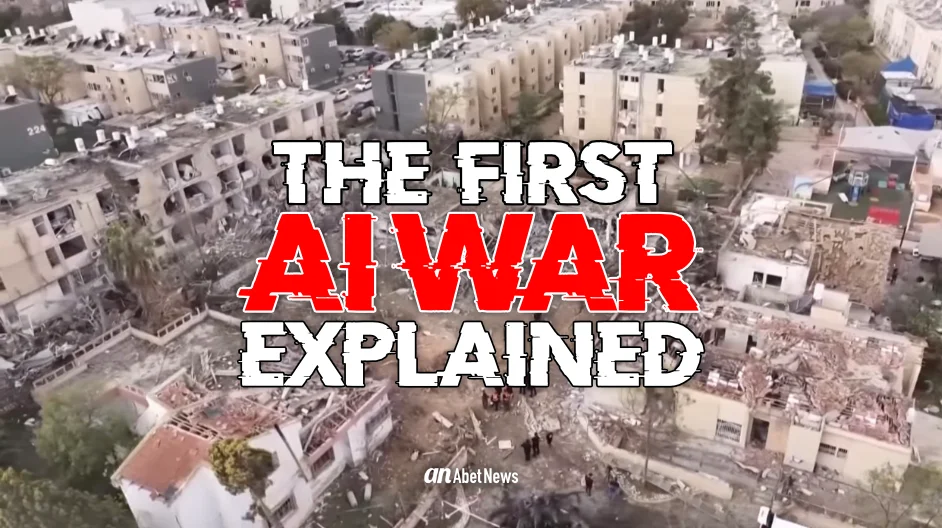
When AI Became Wartime Infrastructure
The US-Israel campaign on Iran isn’t just the first AI war — it’s proof that the technology has graduated from tool to backbone
Abet News · March 23, 2026
For years, AI in the military was discussed in the future tense. Autonomous drones, intelligent targeting, machine-speed decision-making — compelling concepts that defense contractors pitched in PowerPoints and researchers debated in policy journals. The war on Iran, which began on February 28, 2026, ended that conversation. AI is no longer a weapon of the future. It is infrastructure — as foundational to modern military operations as logistics, communications, or airpower.
The numbers make the case plainly. In the first 24 hours of coordinated US-Israeli strikes, allied forces executed approximately 1,000 targeted operations — a scale that was not operationally possible with traditional military planning. What made it possible was a stack of AI systems working in parallel. The Pentagon’s Maven Smart System used AI algorithms to identify potential targets from satellite and other intelligence data, while Anthropic’s Claude helped military planners sort that information, assign priority scores, and decide on strike sequencing.
This is a meaningful shift in what the word “infrastructure” means for warfare. The effective use of automated systems depends on extensive underlying investment and skilled personnel — the US military’s ability to deploy AI at this scale is the product of decades of trial and error in intelligence gathering, targeting cycles, and joint operations. AI did not arrive on the battlefield overnight. It was built into the foundation over years, layer by layer, until it became load-bearing.
Israel brings its own parallel architecture. The IDF’s proprietary AI targeting systems — known as The Gospel and Lavender — process drone footage and signals intelligence to identify strike locations and assign behavioral suspicion scores to individual operatives. These systems were first deployed at scale in Gaza; Iran is where they are being stress-tested at the largest operational scale ever recorded. Meanwhile, Iran is not a passive participant. Its response has included a cyber campaign deploying ransomware-style attacks and data-wiping operations, and on March 1, Iranian forces struck three Amazon Web Services data centers in the UAE and Bahrain — directly targeting the cloud infrastructure supporting US military and intelligence networks.
That last point deserves particular attention from a technology perspective. When a nation-state targets data centers as a first-order military objective, it is treating cloud infrastructure as equivalent to a command center or weapons depot. The logical implication is clear: AI systems are not auxiliary to the war effort — they are the war effort, and adversaries have already internalized that.

The US military’s deep integration with technology companies is not a recent development. The commercial internet itself traces back to ARPANET, a military-funded Cold War communications project. Palantir emerged from CIA-backed venture funding. Project Maven launched in 2017. Amazon Web Services hosts classified military workloads at the top-secret level. What the Iran campaign has done is make that infrastructure visible — and prove it operational at a scale and speed previously theoretical.
The governance questions are real and unresolved. International discussions on regulating AI in warfare are ongoing, with the UN Convention on Certain Conventional Weapons review conference scheduled for November 2026 expected to examine lethal autonomous weapons systems — and more than 120 countries are now supporting negotiations toward new legal instruments. That process will matter enormously. But the Iran conflict has already set a precedent that no policy framework has yet caught up to: AI is now strategic military backbone, and any nation that has not treated it as such is, by definition, operating at a structural disadvantage.
The first AI war is not a warning about the future. It is a document of the present.
David Frein
© 2026 Abet News. All rights reserved.
Related Posts




Apple TV+

JMI Construction