Wikipedia vs. Grokipedia
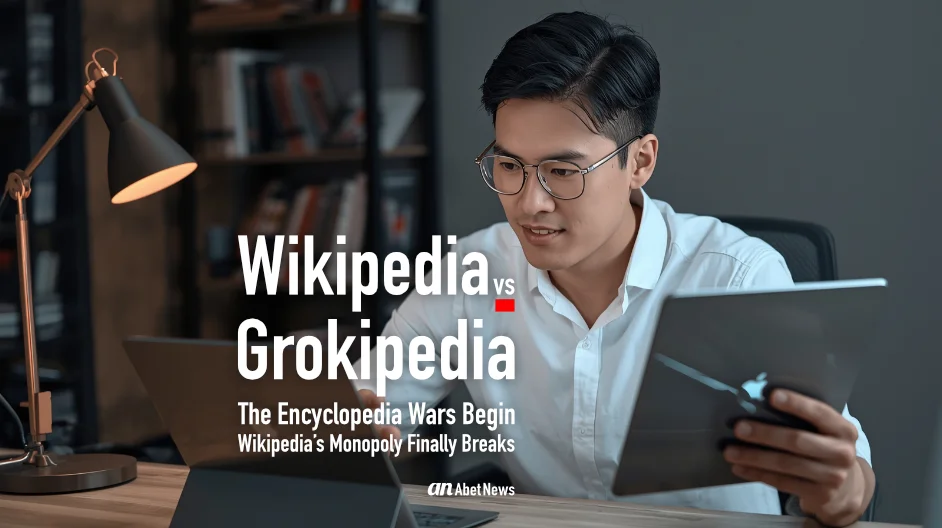
The Encyclopedia Wars Begin: Wikipedia’s Monopoly Finally Breaks
For twenty years, the internet has lived under a quiet epistemic monopoly. Not Google. Not OpenAI. Wikipedia.
It is the invisible backbone of the modern knowledge economy — the source behind the sources. Search engines scrape it. Voice assistants quote it. AI models ingest it. Journalists lean on it. Billions of people unknowingly depend on it.
And that concentration of informational power has shaped the world far more than most people realize.
The Structural Problem: A Monopoly Masquerading as Neutrality
Wikipedia’s defenders insist the platform is neutral. But neutrality collapses under the weight of its own architecture.
Editing Wikipedia at scale requires:
• time
• bureaucratic fluency
• comfort with academic norms
• willingness to argue for hours over a single clause
Those traits cluster in professions that lean left: academia, journalism, law, nonprofits. The result is not a conspiracy — it’s a demographic inevitability. A small, ideologically aligned group shapes the “consensus” that the rest of the world consumes as fact.
This worldview is reinforced by Wikipedia’s source‑reliability regime:
• Conservative outlets are labeled “generally unreliable.”
• Progressive outlets are labeled “generally reliable.”
• State‑funded foreign broadcasters often outrank major American publications.
The rules are presented as neutral. Their outcomes are not.
The Double Standards Are No Longer Subtle
The distortions become clearest in politically charged cases — the places where neutrality matters most.
• Immigration detention: Trump‑era facilities were labeled “concentration camps,” while attempts to note that the same structures were built under Obama were deleted.
• Criminal suspects: Kyle Rittenhouse, acquitted of all charges, was named everywhere. A repeat offender in a high‑profile murder case was shielded because he wasn’t convicted yet.
• Authoritarianism: Donald Trump has a page linking him to fascism. Raul Castro and Khomeini — actual authoritarian rulers — do not.
• COVID origins: The lab‑leak hypothesis was dismissed as conspiracy long after intelligence agencies deemed it plausible.
These are not isolated incidents. They are the fingerprints of a worldview embedded in the platform’s editorial DNA.
Enter Grokipedia — The First Real Counterweight
Grokipedia is new, imperfect, and occasionally wrong — but it breaks the monopoly. It does not inherit Wikipedia’s entrenched editorial culture. It does not rely on the same narrow set of “approved” sources. And early comparisons show it treats contested topics with more balance than the supposedly neutral incumbent.
The point is not that Grokipedia is flawless. It’s that Wikipedia is no longer the only gravitational center.
For the first time in two decades, the internet has a competing reference frame.
Truth Survives Through Competition, Not Consensus
You cannot fix Wikipedia by begging for fairness. You cannot reform a system whose biases are structural. You can only dilute its power.
A healthy information ecosystem requires:
• multiple reference sources
• transparent editorial philosophies
• competing truth‑claims
• users who cross‑check rather than defer
A world with one encyclopedia is a world with one ideology.
A world with many is a world where truth has to compete.
And competition is the only thing that keeps power honest.

The New Reality
The encyclopedia wars are not a crisis. They are a correction — the return of pluralism to a domain that forgot it needed any.
Wikipedia will not disappear. Grokipedia will not replace it. But the era of a single, unchallenged arbiter of truth is ending.
And that is the healthiest development the internet has seen in years.
Andy Young
Abet News | February 18, 2026
Related Posts




Apple TV+
JMI Construction