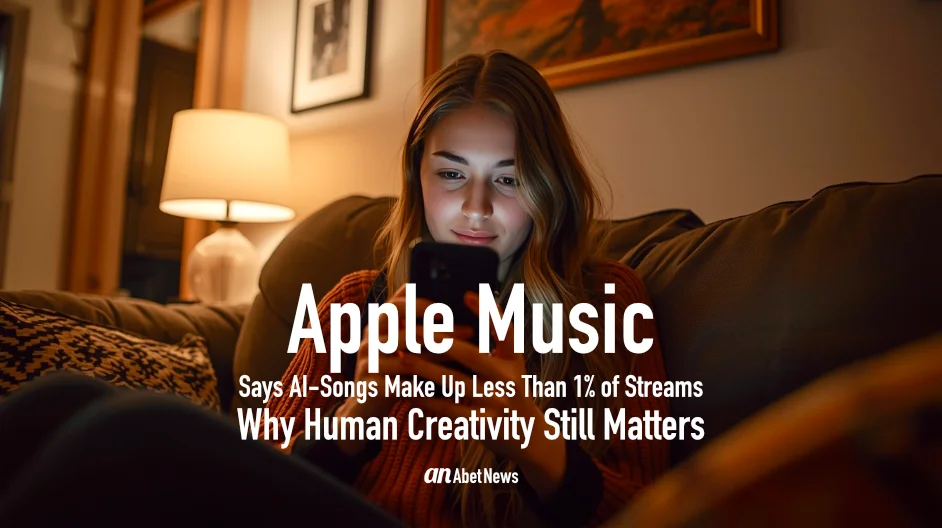
Apple Music Says AI-Songs Make Up Less Than 1% of Streams — Why Human Creativity Still Matters
Abet News · April 25, 2026
The AI music flood is no longer theoretical.
According to recent statements from Apple Music executives, fully AI-generated songs now make up a massive portion of uploads arriving at streaming platforms every day. Some industry reports suggest that more than a third of incoming music submissions may now be entirely AI-generated.
And yet, despite the explosion in synthetic content, Apple Music says AI-generated tracks still account for less than 1% of actual plays on the platform.
That contradiction may reveal something far more important than the rise of AI music itself.
It suggests that while AI can generate infinite sound, listeners still overwhelmingly choose human connection.
The Internet Can Now Generate Music at Scale
The barriers to music creation have collapsed.
With modern generative AI tools, anyone can now create:
• instrumental tracks,
• vocal performances,
• ambient playlists,
• cinematic scores,
• lo-fi streams,
• even entire albums,
often in minutes.
For streaming platforms, this changes everything.
The problem is not necessarily one AI-generated hit song. The larger concern is volume.
Platforms are increasingly dealing with:
• mass-uploaded AI albums,
• fake artists,
• royalty farming,
• playlist manipulation,
• bot-generated streams,
• and algorithmic clutter.
In other words, the challenge is less about creativity and more about platform integrity.
If discovery systems become overwhelmed by low-effort synthetic content, recommendation quality suffers. Independent artists become harder to surface. Listener trust slowly erodes.
Streaming platforms depend on discovery.
Once discovery breaks, culture fragments.
That is likely why Apple Music is taking a more aggressive stance toward AI-generated uploads and fraud detection.
Apple Is Protecting More Than Music
Apple’s response appears strategic.
Unlike platforms optimized purely for scale and engagement, Apple has long positioned itself around premium creative experiences. Music, for Apple, is closely tied to artistry, identity, and emotional storytelling.
Allowing streaming ecosystems to become flooded with synthetic spam risks damaging that perception.
Apple reportedly plans to expand:
• AI detection systems,
• anti-fraud protections,
• metadata transparency,
• and labeling initiatives designed to identify manipulated or fully AI-generated content.
The company is not rejecting AI entirely.
It is attempting to control the quality and authenticity layer surrounding it.
That distinction matters.
Listeners Still Want Humans
The most fascinating part of this story is not technological.
It is psychological.
Despite the rapid improvement of generative music systems, audiences still overwhelmingly gravitate toward human artists.
Why?
Because music is rarely just sound.
Music carries:
• memory,
• vulnerability,
• identity,
• heartbreak,
• rebellion,
• spirituality,
• personality,
• and imperfection.
AI can imitate structure.
It can imitate genre.
It can imitate mood.
But emotional gravity is harder to automate.
Listeners may experiment with AI-generated tracks for productivity playlists, background ambiance, or novelty. But when people search for songs that define moments in their lives, they still tend to seek artists with stories, presence, and humanity behind the music.
That may explain why AI uploads are exploding while actual listener demand remains comparatively tiny.
The Future of Music Will Likely Be Hybrid
The conversation around AI music is often framed too simply:
human music versus AI music.
Reality will probably look far more blended.
Modern music production already relies heavily on AI-assisted tools:
• mastering,
• vocal cleanup,
• stem separation,
• recommendation engines,
• mixing assistance,
• and composition support.
Many future albums will almost certainly involve AI somewhere in the creative pipeline.
The more meaningful distinction may become:
• artist-led creation,
versus
• fully automated content generation.
That line could define the next era of streaming culture.
Authenticity May Become More Valuable
Ironically, the rise of AI-generated media may end up increasing the cultural value of genuinely human art.
As the internet becomes saturated with synthetic content — AI music, AI imagery, AI articles, AI influencers — audiences may begin craving signals of authenticity more than ever before.
Not perfection.
Not scale.
Not infinite output.
Presence.
The artists who stand out in the AI era may not be the ones producing the most content, but the ones capable of creating emotional resonance that algorithms still struggle to replicate.
Apple Music’s “less than 1%” statistic may ultimately point toward something surprisingly hopeful:
Human creativity still matters.
Amy H.
© 2026 Abet News. All rights reserved.
Related Posts


Apple TV+
JMI Construction