Designed in California, Built on a Secret: Apple’s Hidden Dependency on Israeli Military Intelligence Engineers
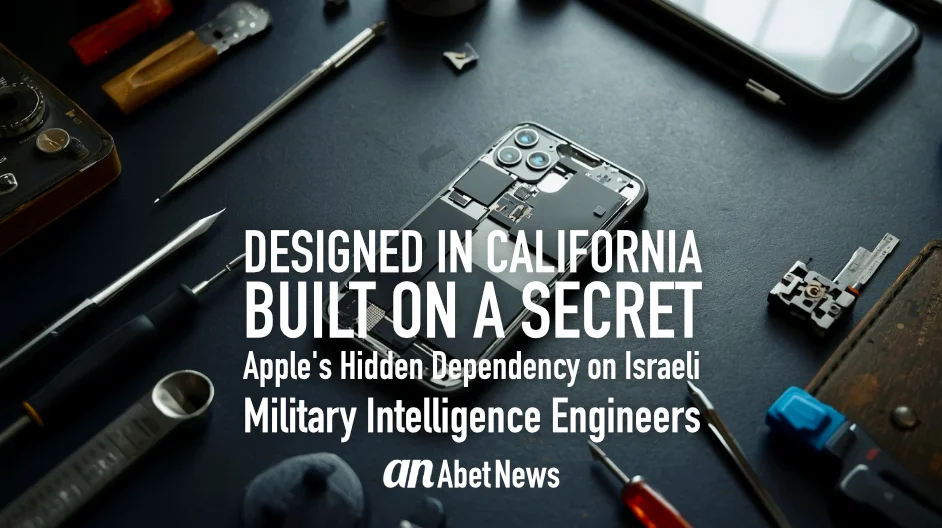
Apple’s chips are powering the iPhone, the Vision Pro, and the AI cloud. The engineers who designed them came from Israel’s most secretive military intelligence unit — and Apple has never said a word about it.
ABET NEWS | TECH IN WAR | JUNE 24, 2026
Every iPhone Apple has sold in the last five years contains a chip engineered, at least in part, in a country Apple doesn’t mention by name. Every Mac laptop running Apple Silicon carries architecture shaped by engineers whose previous employer wasn’t a university or a rival tech firm. It was the Israeli Defence Forces.
Apple’s marketing is precise and deliberate. ‘Designed by Apple in California’ is the phrase etched — literally — into the back of its products. It is a statement of origin, of authorship, of identity. It is also, increasingly, a fiction.
‘It’s hard to find an Apple product that doesn’t have some kind of touch from Apple employees in Israel.’ — Rony Friedman, Vice President, Apple Israel
That quote did not come from a leak or an investigation. It came from Rony Friedman, Apple’s own Vice President and head of Apple Israel, speaking at a public conference in Tel Aviv in early 2026. He wasn’t being careless. He was being proud. The problem is that Apple’s customers — and its regulators — have never been told the same thing.
What to know about the Israeli-developed chip in Apple’s iPhone 17e | AJ
The Architecture of Denial
Apple operates three R&D centres in Israel: Herzliya, Haifa, and Jerusalem. The Herzliya site, opened in 2015, is Apple’s second-largest R&D facility in the world outside the United States. It currently employs approximately 2,500 engineers. The Jerusalem site, announced in 2022, was specifically opened to develop future Mac processors. The Haifa facility, built partly from engineers laid off by Texas Instruments, handles connectivity and wireless systems.
These are not peripheral operations. According to multiple Israeli media accounts corroborated by Apple executives themselves, the Herzliya team designed the M1, M1 Pro, and M1 Max chips that powered Apple’s break from Intel — the most significant architectural shift in Mac history. The same team is now leading development of Apple’s first dedicated AI server chip, internally codenamed ‘Baltra,’ targeting production in 2026 or 2027 via TSMC’s N3P process. The M2 and R1 chips inside the Apple Vision Pro — the device Apple calls its ‘most ambitious product ever’ — were also, Friedman confirmed at a Tel Aviv technology conference, ‘developed largely at the company’s Israeli R&D centre.’
And the C1 modem — Apple’s first in-house cellular chip, debuted in the iPhone 17 — was developed in Israel. So was the N1 connectivity chip. Friedman confirmed both publicly. Apple’s press releases confirmed neither.
Apple’s press releases have never named Israel. Its product pages don’t mention it. Its supply chain disclosures don’t enumerate it.
Apple’s press releases have never named Israel. Its product pages don’t mention it. Its supply chain disclosures don’t enumerate it. Apple’s own website states: ‘Apple products are designed in California and built by people all over the world.’ Israel is, apparently, part of ‘all over the world’ — a geography so vague it renders the disclosure meaningless.
The Pipeline: From Unit 8200 to Cupertino
The story of how Israeli talent came to dominate Apple’s most critical hardware division begins not in Silicon Valley but in the Israeli Defence Forces, specifically in a unit the IDF officially does not discuss.
Unit 8200 is Israel’s signals intelligence and cyberwarfare division. It is the Israeli equivalent of the NSA, and by some assessments its technical superior in certain domains. According to the Royal United Services Institute, it is ‘probably the foremost technical intelligence agency in the world.’ Its recruits are selected at eighteen from Israel’s most mathematically gifted high school graduates and trained in signals interception, cryptography, AI, and cyber operations under conditions of intense secrecy. They are not permitted to publicly acknowledge their membership.
When they leave — typically in their mid-twenties — they are among the most sought-after engineers on the planet. Apple has been recruiting them for over a decade.
A MintPress News investigation published in 2025 identified dozens of Unit 8200 veterans now working at Apple in engineering, chip design, machine learning, and cybersecurity roles. The roster includes Nir Shkedi, a former Unit 8200 commander who led AI tools development for the IDF from 2008 to 2015 — tools later used to generate targeting lists in Gaza — and who has worked as a physical design engineer at Apple since 2022. It includes Noa Goor, who led cybersecurity and big data projects for the IDF before joining Apple as a system-on-chip design engineer in 2022. It includes Eli Yazovitsky, directly recruited from Unit 8200 to become an Apple engineering manager. The list goes on.
Apple is not alone. A database assembled by an independent researcher and reviewed by Drop Site News identified approximately 1,400 veterans of Israeli intelligence agencies — roughly 900 from Unit 8200 alone — currently employed in senior and mid-level engineering and security roles across major US technology firms. Microsoft employs approximately 250. Google at least 99. The figure for Apple has not been independently quantified, but the MintPress investigation identified dozens in chip-specific roles alone.
No other country has this kind of access to the American tech sector. We obsess over Chinese involvement but Israeli penetration rarely gets mentioned.
‘This does not mean that every person who served in Unit 8200 is an Israeli spy,’ the researcher noted. ‘But it does create a serious vulnerability. No other country has this kind of access to the American tech sector. We obsess over Chinese involvement in the tech industry and worry about corporate espionage, but Israeli penetration rarely gets mentioned.’
That asymmetry is the point. The same political class that has spent a decade legislating against Chinese engineers at American chip firms has said nothing about the systematic pipeline of Israeli military intelligence veterans into the architecture teams of every major US semiconductor designer. The scrutiny is not applied evenly.
The Branding as Cover
‘Designed by Apple in California’ is not an accident of marketing. It is a legal and reputational structure. It positions Apple — and only Apple — as the author of its products. It implies a geography and a workforce. It obscures both.
Apple has used this framing as a shield against scrutiny on Chinese assembly, on Vietnamese labour, and now, implicitly, on Israeli military-adjacent R&D. The supply chain disclosure on Apple’s website acknowledges ‘thousands of supplier facilities in over 60 countries.’ It does not distinguish between a bolt manufacturer in Vietnam and a chip architecture team staffed by IDF intelligence veterans in Herzliya.
This matters beyond optics. The engineers building Apple’s most sensitive silicon — the chips inside your phone, your laptop, your headset — are alumni of a foreign military intelligence apparatus whose operational history includes mass surveillance of civilian populations, AI-assisted kill lists, and, according to testimony from former unit members, the use of personal data including medical records and sexual history as leverage for coercion. Apple’s public position on privacy is that it is non-negotiable. Its hiring record tells a more complicated story.
What Accountability Would Look Like
Apple is not legally required to disclose the nationality of its R&D operations. There is no framework that compels an American company to tell its customers that its chips were designed by engineers trained in a foreign military intelligence unit. That regulatory gap is not an accident either.
But the absence of a legal obligation does not neutralise the journalistic or ethical question. Apple has built its brand — and much of its $3 trillion valuation — on the claim that it is a privacy-first company that designs its own products on its own terms. The Israel dependency challenges both claims simultaneously: it is a foreign R&D relationship of structural significance that Apple has actively chosen not to communicate, and it runs through a talent pipeline with documented ties to some of the most invasive surveillance operations in the modern world.
The Baltra AI chip — Apple’s attempt to build server-side AI infrastructure to compete with Nvidia — is being designed by the same Herzliya team, in collaboration with Broadcom, and will be fabricated by TSMC. Apple’s AI future, in other words, is being architected in Israel, manufactured in Taiwan, and sold to the world as Californian.
Friedman was not wrong to be proud. The Israeli team’s engineering output is, by any technical measure, extraordinary. The M-series chips that displaced Intel are among the most significant processor designs of the last decade. The R1 chip in the Vision Pro is unlike anything else in consumer electronics. The C1 modem outperformed Qualcomm on its debut.
None of that makes the concealment acceptable. The world’s most valuable company has built its most important products on a foreign military intelligence pipeline — and has spent a decade telling its customers the work was done in California.
Apple’s AI future is being architected in Israel, manufactured in Taiwan, and sold to the world as Californian.
That is not a supply chain story. That is a structural deception. And it deserves to be treated as one.
David Frein
© 2026 Abet News. All rights reserved.
Related Posts




Apple TV+
JMI Construction