Apple Sues OpenAI Over Trade Secrets
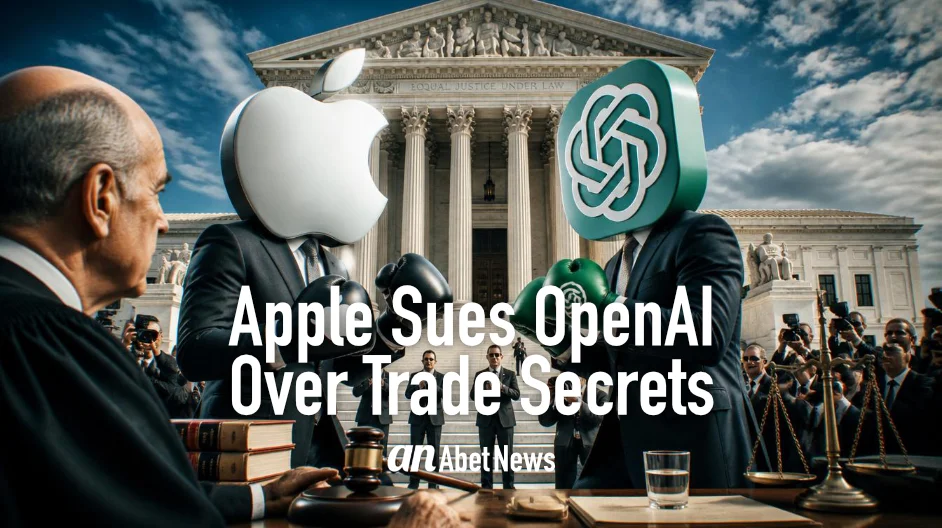
OpenAI has denied the allegations, saying: “We have no interest in other companies’ trade secrets. We remain focused on building innovative technology that empowers people everywhere.”
ABET NEWS · TECHNOLOGY & CORPORATE POWER · JULY 10, 2026
In 2024, Sam Altman stood inside Apple’s Cupertino headquarters to celebrate an alliance that once seemed unthinkable: ChatGPT, baked directly into the iPhone’s operating system, with Apple’s blessing and its brand halo attached. Two years on, the two companies are no longer partners. They are litigants.
On Friday, Apple filed suit against OpenAI Foundation, OpenAI Group PBC, io Products, and two named former Apple employees — Tang Yew Tan, OpenAI’s Chief Hardware Officer, and Chang Liu, a former senior systems electrical engineer — in the U.S. District Court for the Northern District of California. The complaint accuses OpenAI of a coordinated campaign to steal Apple’s trade secrets: product designs, manufacturing processes, and supply chain strategies, allegedly funneled toward OpenAI’s secretive push into consumer hardware.
The language is unusually blunt for a company that prefers understatement. “At every level, from members of its Technical Staff to its Chief Hardware Officer,” the filing states, OpenAI “has been stealing Apple’s trade secrets and confidential information.” Apple calls what it has uncovered so far merely “the tip of the iceberg.”
What the Filing Actually Alleges
Strip away the rhetoric and the complaint describes something closer to institutional habit than isolated incident. Tan, who spent 24 years at Apple rising to VP of product design for iPhone and Apple Watch, is accused of using Apple’s confidential project code names during OpenAI recruiting conversations, of asking candidates to bring Apple hardware components to interviews, and of coaching departing employees on how to slip past Apple’s exit security procedures. Apple also alleges Tan emailed himself supplier information before leaving and briefed OpenAI on upcoming meetings with Apple’s vendors.
Liu’s alleged conduct is more mechanical: failing to return a company laptop, using a security bug to pull down more than a thousand pages of confidential manufacturing documents covering Apple’s circuit boards, and advising a colleague being recruited to OpenAI on which internal materials to study before her own interview.
Apple says it flagged concerns to OpenAI directly in February. It says it never got a response. That silence, more than any single stolen document, is what turned an internal investigation into a public lawsuit.

Every Destination Has A Story. Sometimes That Story Becomes Music.
The Partnership That Was Already Dead
The trade-secret claims are the proximate cause of the suit. The real story is what happened to the relationship in between. Apple and OpenAI’s 2024 integration — ChatGPT accessible through Siri, subscriptions sold straight from iOS settings — was framed at the time as Apple outsourcing its AI ambitions rather than admit it had fallen behind. That arrangement has been quietly hollowed out since: this January, Apple said it was turning to Google, not OpenAI, to power the next generation of Apple Intelligence. Last month, Apple finally shipped the long-delayed Siri overhaul it had promised for over a year.
Meanwhile OpenAI has been assembling the one thing Apple has always treated as sacred: a hardware division. Its acquisition of Jony Ive’s startup io Products, for roughly $6.4 to $6.5 billion, brought in Apple’s former design chief along with more than 50 of his engineers. Notably, io Products is named as a defendant in Friday’s suit — but Ive himself is not, nor is he accused of wrongdoing.
According to Apple’s own filing, more than 400 former Apple employees are now working at OpenAI. That is not stray poaching. It is a talent pipeline, and Apple’s lawsuit is, among other things, an attempt to put a price on what has moved through it.
Why This Is Bigger Than One Lawsuit
Reduce this to a labor dispute and you miss what is actually at stake. Apple has spent two decades building its entire market identity around secrecy — the idea that nothing leaks, that surprise is the product. OpenAI, for all its talk about openness, is now accused of running exactly the kind of opaque, insider-fed operation that Apple claims to guard against. If the allegations hold, OpenAI didn’t just hire Apple’s people; it allegedly built a system for extracting what those people knew on their way out the door.
OpenAI’s public defense so far is a flat denial — “we have no interest in other companies’ trade secrets” — with no engagement on the specifics Apple has laid out. That is a familiar posture for a company that just came off a courtroom win against Elon Musk over its nonprofit-to-for-profit transition, and one that had a similar trade-secret claim from Musk’s xAI dismissed only last month. A pattern of legal skirmishes doesn’t prove guilt in this one. But it does undercut the idea that OpenAI is simply an unlucky target of litigious rivals.
The timing compounds the stakes. OpenAI is widely expected to pursue a public offering, and a lawsuit alleging that its hardware business — the division meant to diversify it beyond a single-product dependency on ChatGPT — rests on misappropriated IP is exactly the kind of overhang that spooks underwriters and investors alike. Apple, for its part, is picking this fight from a position of towering scale advantage, but from a defensive one: it lost the AI-assistant race, is now leaning on Google to catch up, and cannot afford to also lose the hardware category it invented.
The Question Worth Asking
Whatever a court eventually decides about laptops, code names, and metal-finishing techniques, the more durable story here is about how AI companies are built right now: less through invention from scratch, more through the wholesale import of expertise, habits, and institutional knowledge from the incumbents they aim to disrupt. Apple’s lawsuit is a legal document, but it’s also a warning shot to every AI company recruiting from the same shrinking pool of hardware and design talent — that the line between aggressive hiring and outright theft is a lot thinner, and a lot more contested, than Silicon Valley has been willing to admit.
David Frein
© 2026 Abet News. All rights reserved.
Related Posts



#AbetNews, #AllegedTradeSecretTheft, #AppleOpenAILawsuit, #AppleSuedOpenAI, #AppleTradeSecretLawsuit, #Article, #ArtificialIntelligence, #ChangLiu, #DavidFrein, #Industry, #IndustryImpact, #JonyIve, #OpenAI, #OpenAIHardware, #OpenAIIPORisk, #TangTan, #Tech, #TechIndustry, #TechNews, #Technology, #TradeSecretTheft
Apple TV+
JMI Construction