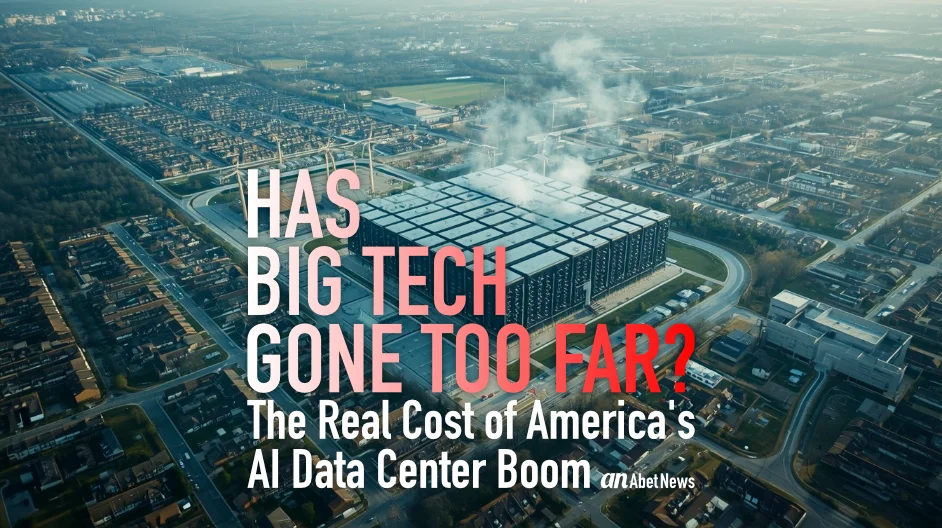
Has Big Tech Gone Too Far? The Real Cost of America’s AI Data Center Boom
ABET NEWS · OPINION / TECHNOLOGY · MAY 31, 2026
The promises were familiar. Jobs. Innovation. A competitive edge in the race to define the next century of technology. What communities across the United States were not told — often by design — is what the infrastructure behind those promises would actually cost them: their water, their air, their sleep, and in some cases, their health.
The numbers are no longer deniable. The AI data center boom is one of the most consequential and underexamined industrial expansions in modern American history, and the damage it is leaving in its wake is beginning to look less like an acceptable tradeoff and more like a public health emergency hiding behind a press release.
The Energy Reckoning
U.S. data centers currently draw roughly 80 gigawatts of power. By 2028, that figure is projected to reach 150 gigawatts — nearly double, in three years. To put that in context: the United Kingdom, a nation of 67 million people, consumes approximately 30.7 gigawatts on average. The AI industry is building toward consuming five times that amount just to keep its servers running.
The International Energy Agency estimated that global data center electricity generation produced approximately 182 million tons of CO₂ emissions in 2024 alone. The carbon footprint of AI systems specifically — not all data centers, just AI workloads — could reach between 32.6 and 79.7 million tons of CO₂ in 2025. Researchers have described that upper bound as comparable to the total annual carbon footprint of New York City.
These are not projections designed to alarm. They are the measured outputs of peer-reviewed research and intergovernmental reporting, and they describe a trajectory that the industry has shown little credible urgency to alter.
The Water That Doesn’t Come Back
Power consumption is visible on an energy grid. Water consumption is easier to hide.
AI data centers consumed approximately 17 billion gallons of water in 2023. By 2028, that number is projected to reach 68 billion gallons — a 300 percent increase in five years. A single large facility can consume up to 5 million gallons per day, drawing directly from local water supplies in regions that are already under stress.
The water is used primarily for cooling. Servers generate enormous heat; that heat must be managed or the hardware fails. The most common method — cooling towers — relies on the continuous withdrawal and evaporation of freshwater. It is not recycled. It is gone.
In water-scarce communities across the American West and Midwest, environmental groups are now demanding compensation for potable water use that, until recently, was happening with little public disclosure and less public consent. In Minnesota, local organizations have pushed for mandatory reuse and recycling requirements. Elsewhere, residents have discovered the scale of their water losses only after the facilities were already operational.
This is not a coincidence. It is a consequence of deliberate opacity.
The Air and the Noise
Less discussed but equally documented is what living near a data center does to the people who have no choice but to remain there.
A national analysis of approximately 700 data centers found that nearly half are located in census tracts already carrying above-median environmental burdens — communities disproportionately affected by air pollution, limited green space, and water contamination. The AI buildout is not distributing its costs evenly. It is concentrating them in places with the least political leverage to push back.
Air quality is a direct concern. Data centers rely on diesel backup generators that run during grid outages and, critically, during routine load testing — which can occur without warning and at any hour. A 2025 study projects that U.S. data centers by 2030 could cause approximately 600,000 asthma symptom cases annually and contribute to an estimated 1,300 premature deaths — exceeding one-third of all asthma deaths in the country each year. The projected public health cost: more than $20 billion.
The noise is chronic and, for many residents, psychologically destabilizing. Data centers operate continuously, and the industrial-scale cooling equipment required to keep them functional generates a persistent low-frequency hum that penetrates walls, disrupts sleep, and — according to environmental health research — is associated with hypertension, cardiovascular disease, and anxiety. One Virginia resident living adjacent to a Google facility described load-testing noise as triggering panic attacks severe enough to prevent sleep. In Chandler, Arizona, residents spent nearly a decade filing complaints about unceasing noise before the city finally amended its zoning code in 2022 to make siting new data centers harder. In 2025, the city council voted unanimously to block a newly proposed facility.
The Secrecy Behind the Steel
What makes the scale of this problem particularly troubling is how systematically it has been obscured.
A review of 31 Virginia municipalities with existing or proposed data center development found that 80 percent had entered non-disclosure agreements with developers — agreements that limit public access to information about project scale, resource demands, and potential impacts. Residents in these communities are legally prevented from knowing what is being built next to them, how much water it will consume, or what emissions it will produce.
The federal government has done little to change this dynamic. An executive order issued in mid-2025 accelerated environmental review timelines and streamlined regulatory processes specifically to hasten the buildout. The message from Washington was clear: speed matters more than scrutiny.
The Communities That Are Fighting Back
What has changed — and this is the development that the industry did not anticipate — is that communities are no longer simply absorbing the costs.
In 2025, organized local opposition led to the delay or cancellation of AI data center projects totaling $156 billion. Between May 2024 and March 2025 alone, more than $64 billion in projects were blocked or delayed due to community resistance. A $14 billion development in Arizona was withdrawn after local authorities declined to rezone in response to resident pressure. In Indianapolis, Google’s plans faced months of opposition from residents before a public retreat. In New Brunswick, New Jersey, community advocates successfully forced the cancellation of a proposed facility outright.
New York State lawmakers are now considering a three-year moratorium on large new data center projects while the state formally assesses their environmental and energy impacts. It is the kind of legislative pause that would have seemed unthinkable two years ago, when AI infrastructure was treated as categorically exempt from the scrutiny applied to other industrial development.

The Question That Remains
None of this is an argument against artificial intelligence. The technology is real, its applications are consequential, and the geopolitical stakes of falling behind in AI capability are legitimate. These are not reasons to pretend the infrastructure doesn’t exist.
What the data demands — calmly, clearly, and without ideological embellishment — is accountability proportional to impact. The AI industry has spent years insisting that its environmental commitments are serious, while greenhouse gas emissions from major tech companies have risen, water withdrawals have accelerated, and the communities absorbing the costs have been kept in the dark by legally binding secrecy agreements.
Big Tech has not gone too far by building AI infrastructure. It has gone too far by insisting that the public bear the costs of that buildout without the information, the consent, or the legal protections that any other industrial sector would be required to provide.
The bill has come due. The only question now is who is being asked to pay it — and whether they had any say in the matter.
David Frein
© 2026 Abet News. All rights reserved
Related Posts




Apple TV+

JMI Construction