In the Age of AI Design, Are We Forgetting User Experience?
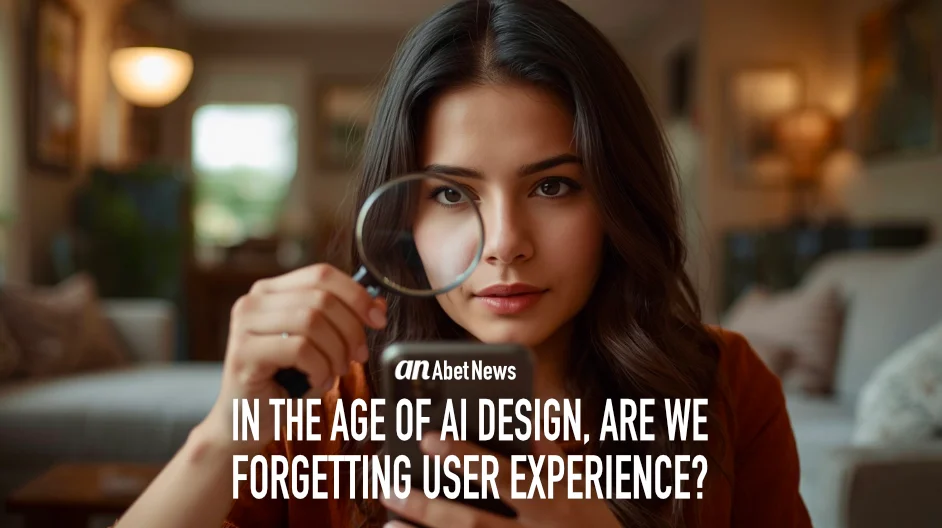
ABET NEWS – THE HUMAN FACTOR – JUNE 21, 2026
The Growing Disconnect Between UI and UX
For years, the technology industry has celebrated innovation in user interface design. New visual languages, fresh layouts, animated transitions, glass-like effects, dynamic menus, and AI-generated design concepts have become hallmarks of modern software development.
Yet many users are asking a simple question:
Why does everything feel harder to use?
Despite incredible advances in design tools, artificial intelligence, and software development, there appears to be a growing disconnect between User Interface (UI) and User Experience (UX). The result is an increasingly common frustration among users who find themselves taking more steps, spending more time, and exerting more effort to complete tasks that once felt simple.
In an era where AI can generate entire applications in minutes, perhaps the industry has become too focused on creating interfaces and not focused enough on creating experiences.
UI Is Not UX
The terms UI and UX are often used interchangeably, but they represent very different concepts.
UI refers to the visual presentation of a product. It includes colors, typography, buttons, menus, icons, animations, and layouts.
UX refers to the overall experience of using the product. It asks a different set of questions:
• Can users find what they need quickly?
• Can they complete tasks efficiently?
• Is the workflow intuitive?
• Does the product reduce frustration?
• Does it save time?
A beautiful interface does not automatically create a good experience.
In fact, some of the most visually stunning applications today require significantly more effort to use than their predecessors.
The “Let’s Move It” Syndrome
Many users have experienced the same scenario.
An app receives a major update.
The release notes proudly announce a refreshed design and a modern interface. Users open the app expecting improvements.
Instead, they spend the next ten minutes searching for features that used to be obvious.
The button still exists.
The setting still exists.
The workflow still exists.
Everything has simply been moved.
Unfortunately, moving interface elements does not necessarily improve usability. Sometimes it creates confusion where none previously existed.
Many redesigns appear driven by visual novelty rather than measurable user benefit.
The result is what some users describe as “change for the sake of change.”
More Taps, More Menus, More Friction
One of the easiest ways to evaluate a user experience is through a simple metric:
How many steps does it take to complete a task?
Mobile devices make this especially important.
Screen space is limited. Attention spans are limited. Users often interact with their phones while multitasking, commuting, shopping, or working.
Consider a common example.
Before a redesign:
1. Open app.
2. Tap button.
3. Task completed.
After a redesign:
1. Open app.
2. Tap profile.
3. Open settings.
4. Select preferences.
5. Navigate to advanced options.
6. Locate feature.
7. Complete task.
The functionality remains unchanged, but the user experience has objectively deteriorated.
When software requires more effort to achieve the same result, users notice.
The Accessibility Problem Nobody Talks About
Another growing concern involves readability.
Modern design trends frequently favor:
• Low-contrast text
• Thin typography
• Semi-transparent overlays
• Glass-like effects
• Subtle color palettes
These elements often look attractive in design mockups and marketing presentations.
Real-world usage tells a different story.
Users read text outdoors in sunlight.
They use devices while tired.
Many users wear glasses.
Many users are older than the designers creating the interfaces.
Tiny gray text on a slightly darker gray background may appear elegant in a design studio, but it can become frustrating in everyday life.
Accessibility should not be treated as an optional feature. It is a fundamental component of good user experience.
A design is not successful because text can technically be read.
A design is successful when text can be read comfortably and instantly.
Good Design Is Often Invisible
The best user experiences share a common characteristic.
Users rarely think about them.
When software feels natural, people focus on accomplishing their goals rather than navigating the interface.
The interface fades into the background.
The task takes center stage.
When users begin asking:
• Where did that button go?
• Why is this harder?
• Why is the text so small?
• Why are there more steps?
the interface has become the story.
And that is usually a sign that something has gone wrong.
Synthetic Empire – Music and Storytelling: follow investigative journalist Anabel Kaspario as she uncovers the dark intersections of AI technology.
It isn’t really about technology—it is about people.
For decades, the best software followed a simple philosophy:
“Don’t make me think.”
Today, many products seem to follow a different philosophy:
“Look what we changed.”
The AI era is making it easier than ever to redesign, refresh, and rebuild. The challenge for the next generation of designers won’t be creating more interfaces—it will be protecting the user experience from unnecessary complexity.
In many ways, the most revolutionary design trend of the next decade may not be more animation, more AI, or more visual effects.
It may simply be:
• Fewer taps.
• Better contrast.
• Clearer navigation.
• Consistency.
• Respect for users’ time.
Those principles never go out of style.
And they apply equally to companies like Apple, Google, Microsoft, startups, websites, and AI-powered products.
“Just because AI can redesign something doesn’t mean it should. The measure of progress isn’t how different an interface looks—it’s how easily people can use it.”
Petra Lugar
© 2026 Abet News. All rights reserved.
Related Posts




Apple TV+

JMI Construction