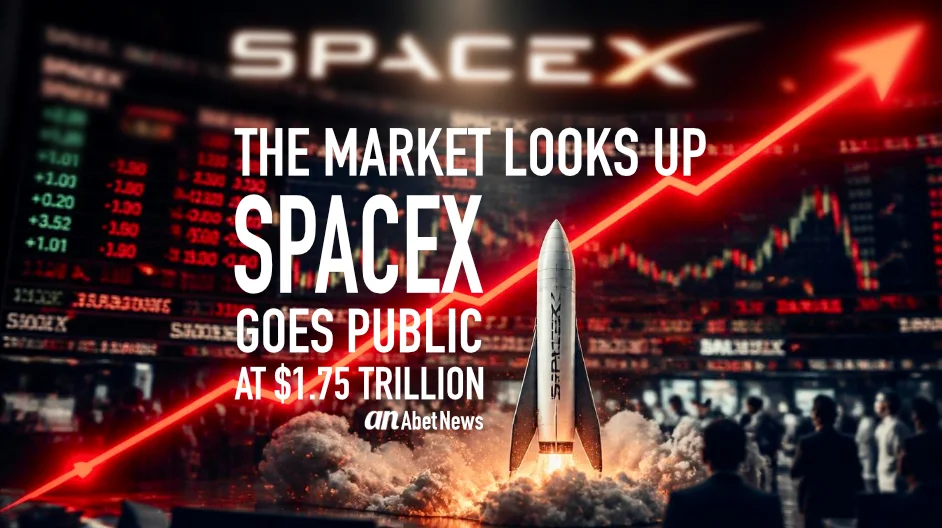
The Market Looks Up: SpaceX Goes Public at $1.75 Trillion
ABET NEWS – MARKETS – JUNE 12, 2026 – Updated Jun 16, 2026
SpaceX goes public at $1.75 trillion. What the largest IPO in history tells us about the kind of belief a market can sustain.
SpaceX priced its shares at $135 on the evening of June 11. By the time Nasdaq opened this morning, SPCX was already trading above $150. By midday it had touched $176. The company’s market capitalization, at peak, exceeded $2 trillion — briefly overtaking Apple.
It is the largest IPO in history by every measure. The $75 billion raise dwarfs Saudi Aramco’s 2019 record. And unlike Aramco, which listed a state oil monopoly at a government-set price, SpaceX sold something considerably harder to value: a story about what comes after Earth.
This is not a bet on what SpaceX is. It is a bet on what the world is willing to believe.
The Numbers Behind the Myth
The S-1 is a document worth reading carefully, because it requires readers to hold two contradictory facts at once. First: SpaceX generated $18.7 billion in revenue in 2025, growing 33% year-over-year. Starlink, the satellite internet business, contributed the majority of that figure and posted a $1.2 billion operating profit in Q1 2026 alone. These are real numbers, not projections.
Second: the company posted a GAAP net loss of $4.94 billion for full-year 2025, accelerating to a $4.28 billion loss in a single quarter this year. The gap is driven by SpaceX’s absorption of xAI — acquired in February 2026 — which recorded a $6.35 billion operating loss in 2025. Starlink’s profits are, in effect, subsidizing an AI venture still searching for its business model.
At $1.75 trillion, investors are paying approximately 94 times 2025 trailing revenue. That multiple is not a valuation of the launch business, or even of Starlink as it stands today. It is a valuation of orbital AI infrastructure, of Starship achieving high-frequency commercial flight, of Starlink becoming the connective tissue of a networked planet. It is a valuation of things that have not happened yet.
What the S-1 Actually Says About Power
The governance structure deserves more scrutiny than the trading desk is giving it. SpaceX’s listing introduces mandatory individual arbitration clauses, restricts derivative suits, and establishes a dual-class share structure that concentrates voting control with the founder. Senator Elizabeth Warren wrote to the SEC last week urging a delay on exactly these grounds.
The SEC did not delay. That is consistent with its mandate — the Commission reviews disclosures, not whether a price is fair or a governance arrangement is equitable. But Warren’s underlying point stands. What SpaceX has built is a structure in which public investors participate in the upside while retaining almost no mechanism to challenge the direction. Capital is welcome. Oversight is not.
This is not unprecedented — Snap’s non-voting shares and Meta’s dual-class structure set earlier templates — but SpaceX’s version is more comprehensive. The litigation shields go further. The Texas incorporation adds another layer of founder protection. Investors entering SPCX today are not buying into a governance relationship. They are buying a ticket to watch.
Starlink Is the Real Company
Strip away the mythology and SpaceX is, at its core, a satellite internet business with a rocket division attached. Starlink closed 2025 with 8.9 million subscribers, crossed 10.3 million by February 2026, and is on a trajectory that analysts at Bloomberg and Quilty Space project could reach $15.9 to $24 billion in 2026 revenue. The recurring, subscription-based economics are what justify the public market interest — not the drama of a Starship launch.
The launch business remains genuinely important — Starship is the infrastructure on which Starlink’s next-generation satellite constellation depends, and SpaceX’s government contracts, totalling $5.9 billion from NASA and the Department of Defense in 2025, underwrite the capital requirements. But the investment thesis, stripped to its core, is a bet that satellite broadband becomes a utility layer for the global economy. That is a credible bet. It does not require cosmic ambition to underwrite it.
The Risk That Doesn’t Fit on a Roadshow Slide
There are at least three risks the roadshow did not spend much time on. The first is China. Long March rockets, subsidized by the state and under no obligation to generate returns, are the closest competitive analogue to SpaceX’s launch economics. A geopolitical decoupling that accelerates Chinese satellite internet development — or closes key markets to Starlink — would compress the total addressable market in ways the S-1’s figures do not reflect.
The second is Musk himself. The company’s S-1 is explicit: it identifies the founder as a key-person risk in unusually direct terms. SpaceX’s valuation is inseparable from his credibility. The xAI controversy that shadowed the roadshow — allegations involving generative AI output that the company has not fully addressed — did not move institutional demand. It will matter more if it recurs at scale.
The third is physics. Starship Flight 12 is scheduled for this month. The Mars colonization narrative, the orbital data center thesis, the Starlink Gen 2 constellation — all depend on Starship achieving reliable, high-frequency flight. A failure in the near term would not crater the stock overnight, but it would begin the slow work of separating the valuation from the myth.

What This Listing Actually Means
SpaceX going public is consequential beyond its own balance sheet. At an expected pre-money valuation of $1.675 trillion, the IPO generates more exit value than all venture-backed IPOs of the past decade combined, according to Morningstar. It clears the runway for OpenAI and Anthropic — both preparing their own listings — to price at multiples that would have seemed absurd without this reference point.
It also tests something about the current moment in capital markets: whether investors have learned anything from the 2020–2021 cycle of narrative-driven valuations that subsequently collapsed, or whether the hunger for stories about the future is structurally immune to that lesson.
The market’s appetite for mythology is not irrational. It is, historically, how transformative infrastructure gets funded. The question is whether this is railroads or it is tulips.
The honest answer is that nobody knows. Starlink’s subscriber growth is real. The launch economics are real. The governance risks are real. The Musk dependency is real. The 94x revenue multiple requires a future that is not yet visible to resolve in the bull case.
What happened today on the Nasdaq is not a verdict on that future. It is a price — subject to revision, as all prices are — on what the market is currently willing to believe. Today, the number is $160 and rising.
We will watch.
Tracy Goodman
© 2026 Abet News. All rights reserved.
Related Posts

Apple TV+
JMI Construction