
The Uber Economy: When the Algorithm Becomes the Boss
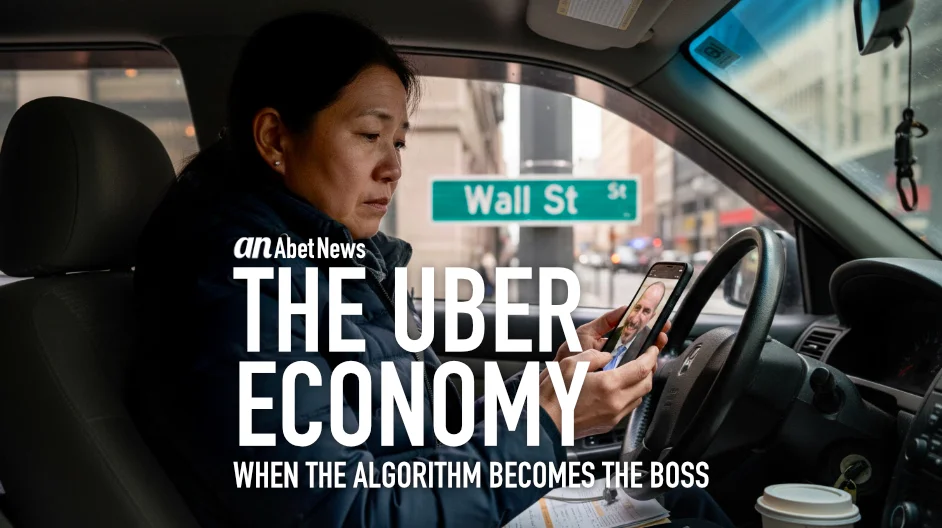
Peer-reviewed research, a driver on-record, and Uber’s own documentation point to the same conclusion: the app isn’t broken. It’s optimized to manipulate the user.
ABET NEWS | EDITORIAL – MARKETS | AUGUST 12, 2026 – AUGUST 23, 2026
There was a time when a worker knew who their boss was.
There was a manager. There was an office. There was a schedule. There was a paycheck.
Today, the boss may be an algorithm.
It doesn’t have a face. It doesn’t raise its voice. It doesn’t sit across the desk and tell you that your pay is being reduced.
It simply sends another notification.
$5.83.
$7.14.
$4.91.
Accept?
You have seconds to decide.
For hundreds of thousands of rideshare drivers, this has become the modern workplace.
And that raises a question we should be asking much more seriously:
When a technology platform controls the price of a customer’s ride, determines what a driver is offered, controls the information available to the driver, tracks the driver’s behavior and influences whether the driver accepts the next job—how independent is that worker really?
This is the Uber economy.
And it deserves a closer look.

Every Destination Has A Story. Sometimes That Story Becomes Music.
The Driver Is Called an Entrepreneur
Uber’s business model has always benefited from a powerful idea: the driver isn’t an employee.
The driver is an independent contractor.
That distinction matters enormously.
An employee generally expects an employer to establish wages, schedules and working conditions.
An independent contractor is supposed to have considerably more control over how they work and what they charge.
But the digital economy has created something unusual.
A worker can technically be independent while operating inside an environment where virtually every economically important decision is mediated by software.
Uber tells drivers the upfront amount they will earn for a trip. The company says that fare is calculated using several factors, including demand, traffic patterns, distance and estimated duration. (Uber)
The driver can accept or reject.
On paper, that sounds like freedom.
But freedom becomes complicated when the worker doesn’t know what the customer paid, doesn’t know what the algorithm considers a sufficiently attractive offer, doesn’t know what the next offer will be and may have incentives tied to their acceptance behavior.
The driver is free to say no.
But the economic system is designed to make saying no consequential.
That is a very different kind of workplace.
The Price the Passenger Pays Is Not Necessarily the Price of Labor
This is perhaps the most important part of the story.
For years, the basic rideshare concept was relatively easy to understand: passenger pays a fare, platform takes a percentage, driver receives the rest.
Modern algorithmic pricing is considerably more complicated.
Uber’s upfront-pricing model allows the company to determine the price presented to the passenger and the amount offered to the driver through separate calculations.
That creates something traditional labor markets rarely provide:
A marketplace where the buyer and the worker can effectively see two different prices for the same transaction.
And independent research suggests that the consequences are significant.
Researchers at the University of Oxford analyzed more than 1.5 million Uber trips involving 258 UK drivers between 2016 and 2024.
Their study found that after Uber introduced dynamic pricing in 2023, driver earnings declined while Uber’s share increased. Inflation-adjusted driver hourly income fell from more than £22 to just over £19 before operating costs. The researchers also found that drivers spent more unpaid time waiting and that Uber’s take rate increased from approximately 25% to 29%, with the researchers reporting that Uber sometimes took more than half of a fare. (Oxford University)
That doesn’t prove that every Uber driver is being systematically underpaid.
It does something more important.
It demonstrates that the economics of the platform changed—and the change was not necessarily favorable to the people performing the work.
The Algorithm Doesn’t Need to Hate You
This is where the conversation about artificial intelligence and algorithms becomes misunderstood.
We often imagine algorithmic abuse as something sinister.
A programmer writes:
“Pay this driver as little as possible.”
But modern algorithmic systems don’t necessarily work that way.
They optimize.
They predict.
They experiment.
They respond to behavior.
They search for efficiencies.
And if the system discovers that a ride can be fulfilled for $6 instead of $9, the algorithm doesn’t need to understand what $3 means to the person behind the steering wheel.
It only needs to know that the ride was accepted.
That distinction is crucial.
An algorithm can produce exploitative outcomes without having an explicit instruction to exploit anyone.
That is one of the defining problems of algorithmic management.
The Trip Radar Problem
Then there is Trip Radar.
Uber describes Trip Radar as a feature that allows multiple drivers to see trip requests simultaneously and choose according to their preferences.
Uber has also stated that Trip Radar changes how trips are displayed and offered but does not itself change how earnings are calculated.
But in February 2026, drivers began reporting an extraordinary problem.
A ride would appear at one price.
The driver would attempt to accept it.
The ride would disappear.
Then the same or apparently identical trip could reappear at a lower payout.
Uber acknowledged a software bug that could cause some drivers to receive a lower payout for the same trip after an earlier offer disappeared. Uber’s chief product officer said the company was working on fixes. (Business Insider)
Uber called it a bug.
And technically, that matters.
A software bug isn’t evidence of a corporate conspiracy.
But from the driver’s seat, there is another question:
What does a bug reveal about the system when the bug consistently affects the economic relationship between the platform and the worker?
That is the question regulators should be asking.
Not:
“Was this intentional?”
But:
“What safeguards exist to prevent the platform from systematically benefiting when the software makes a mistake?”
Ten Seconds to Make an Economic Decision
Imagine being offered a job.
You have ten seconds.
You don’t know what the customer paid.
You don’t know whether a better job is coming.
You don’t know how much time the pickup will actually consume.
You don’t know what traffic will look like.
You don’t know how much fuel and vehicle depreciation the job will consume.
You simply see a number.
Accept or decline.
This is not merely transportation technology.
It is behavioral economics applied to labor.
Every button, countdown, notification, incentive and status indicator can influence behavior.
That doesn’t automatically make the design unethical.
Every business uses incentives.
But the ethical line becomes much more important when the person being influenced is economically dependent on the platform.
A $3 bonus may look insignificant to a corporation.
To someone trying to pay for gasoline, insurance, maintenance and groceries, it can be enough to change a decision.
More Perfect Union, Investigated Uber Again. It’s Worse Than Last Time.
The Psychology of “Just One More Ride”
This is where gamification enters the workplace.
Streaks.
Bonuses.
Acceptance rates.
Status levels.
Promotions.
Milestones.
The psychological mechanism is familiar.
You’ve already completed four rides.
One more and you get the bonus.
You receive a mediocre trip.
Do you reject it and potentially lose the streak?
Or do you accept?
The rational calculation isn’t always:
Is this trip profitable?
It becomes:
Will rejecting this trip cost me something I have already earned?
That’s the sunk-cost effect.
And it is extremely powerful.
The danger isn’t that incentives exist.
The danger is when incentives encourage workers to stop calculating the actual economics of individual jobs.
Because a driver doesn’t live on badges.
A driver lives on net income.
Acceptance Rate Is Not Profitability
This may be the great psychological trick of gig work.
A driver’s acceptance rate can be made to feel like a measure of success.
But acceptance rate isn’t profit.
A driver could accept 90% of trips and lose money.
Another driver could reject 80% of trips and earn considerably more per working hour.
That isn’t hypothetical.
Driver communities regularly debate the economics of rejecting low-value trips, with some drivers arguing that declining unprofitable requests is essential to maintaining their net income. These are anecdotal reports, not controlled studies—but they reveal how differently drivers can experience the same algorithmic marketplace.
And that creates another uncomfortable question:
Why should a worker’s willingness to accept an unprofitable job be treated as a measure of worker quality?
The Information Asymmetry
The most powerful player in any marketplace is often the one with the most information.
Uber knows enormous amounts about its marketplace.
It knows demand.
It knows supply.
It knows geographic patterns.
It knows trip history.
It knows what prices passengers have historically accepted.
It knows how many drivers are available.
It knows when demand spikes.
It knows when drivers reject requests.
The individual driver sees a phone screen.
That is a staggering information imbalance.
And information asymmetry becomes particularly consequential when one side controls the marketplace itself.
The driver isn’t simply competing with other drivers.
The driver is negotiating with a computer system that may have vastly more information about the marketplace than the driver does.
The Driver’s Story
One Uber driver told us:
“I drive UberX around 5 hours per day. For an entire week, Uber did not give me a single fairly paid trip. It would show me a trip, I’d click accept, but the trip would just go away — because I’m not accepting the lower-paying trips.”
We cannot independently verify this driver’s experience.
But we don’t need to.
It illustrates the central problem perfectly.
The driver isn’t saying:
“I want every ride.”
The driver is saying:
“I want rides that make economic sense.”
Those are very different demands.
And if the platform’s answer is essentially to keep presenting offers until somebody accepts, the marketplace starts to resemble a reverse auction.
How little will someone work for?
Who will accept it?
How quickly?
And what happens if everyone says no?
Enter Wall Street
This is where the story becomes bigger than driver complaints.
Uber isn’t a charity.
It is a public company.
It has shareholders.
It has analysts.
It has quarterly earnings.
And it has a stock price.
As of August 10, 2026, Uber closed at $78.03, about 23.5% below its 52-week high of $101.99. On August 5, shares fell roughly 6% after Uber issued a softer-than-expected profit outlook.
But saying “Uber stock fell, therefore Uber is failing” would be intellectually lazy.
The company is not failing.
Far from it.
Uber reported $14.19 billion in second-quarter 2026 revenue, gross bookings of approximately $58.02 billion, and 3.9 billion trips. Revenue increased 12% year over year, while gross bookings rose 24%.
The market’s concern is more complicated.
Growth is moderating.
The company is spending heavily on autonomous vehicles.
And investors are increasingly interested in what Uber becomes after the human driver is no longer the center of the business.
That may be the most fascinating part of the entire story.
The Autonomous Future
Uber is investing approximately $10 billion over the coming years in autonomous vehicles and aims to expand autonomous operations to 15 markets globally by the end of 2026, according to reporting following its second-quarter results. (The Wall Street Journal)
Read that again.
Uber’s present business depends heavily on human drivers.
Uber’s future strategy increasingly involves machines.
That creates a profound economic question.
If drivers are squeezed today while the company builds the infrastructure for a future with autonomous vehicles, what exactly happens to the value of human labor inside the Uber ecosystem?
Are today’s drivers partners?
Temporary infrastructure?
A transitional workforce?
Or simply the last generation of human operators before the algorithm takes control of the vehicle as well?
And What About Regulation?
This is where government enters the story.
The gig economy has spent years fighting over a deceptively simple question:
Are these workers employees or independent contractors?
But perhaps we have been asking the wrong question.
Maybe the law needs a third concept.
Because a worker can be legally independent while being technologically managed.
The old labor laws were written around human managers.
The new workplace may have no manager at all.
Instead, there is software.
Software determines the offer.
Software determines the timing.
Software manages matching.
Software measures behavior.
Software delivers incentives.
Software changes.
And the worker adapts.
That is algorithmic management.
And it is moving far faster than labor law.
What Would a Fair Uber Look Like?
We don’t have to eliminate Uber.
We don’t have to eliminate dynamic pricing.
We don’t have to eliminate algorithms.
We don’t even have to eliminate independent contracting.
But we could demand transparency.
A fair rideshare marketplace could provide drivers with:
The passenger fare.
The driver’s exact percentage or guaranteed share.
The distance to pickup.
The estimated total working time.
The expected expenses.
A clear explanation of how the fare was calculated.
A meaningful appeal process when an algorithm makes an error.
Protection against algorithmic retaliation for declining economically irrational trips.
And perhaps most importantly:
An auditable algorithm.
Not the company’s proprietary source code.
The public doesn’t need Uber’s secret recipe.
But regulators, independent auditors and worker representatives should be able to determine whether the system systematically disadvantages one side of the marketplace.
If an algorithm can determine someone’s income, perhaps someone other than the algorithm’s owner should occasionally be allowed to inspect the results.
The Bigger Question
Uber transformed transportation.
There is no denying that.
It made getting a ride extraordinarily convenient.
It created flexible earning opportunities for millions of people.
It challenged traditional taxi systems.
And it built one of the world’s most sophisticated real-time marketplaces.
But success doesn’t make a system immune from criticism.
In fact, the larger the platform becomes, the more important the criticism becomes.
Because Uber is no longer simply a transportation company.
It is a laboratory for the future of work.
And what happens to Uber drivers today could eventually happen to delivery workers, warehouse workers, freelancers, contractors, call-center workers and countless others.
The question isn’t whether algorithms should manage work.
They already do.
The question is:
Who manages the algorithm?
And who protects the human being on the other side of the screen?
Business Insider: How Uber Uses AI To Charge You More
The Algorithm Has No Conscience
That may ultimately be the lesson.
A human manager can look at a worker and understand that $5 for 30 minutes of work isn’t reasonable.
An algorithm sees an accepted trip.
A human manager may understand that a worker has already driven 20 miles without a passenger.
An algorithm sees another available vehicle.
A human manager may understand that someone is trying to make enough money to survive the week.
An algorithm sees conversion rates.
This is why the debate over Uber isn’t really about Uber.
It is about what happens when optimization becomes more important than human judgment.
Uber’s algorithm doesn’t have to wake up in the morning and decide to exploit drivers.
It only has to optimize the marketplace.
And if the cheapest possible labor produces the best financial result, the system has every mathematical reason to keep searching for the lowest price a human will accept.
That is not necessarily a conspiracy.
It may be something more consequential:
a business model behaving exactly as it was designed to behave.
The driver can always press “Decline.”
But if every decline teaches the machine something about how much pressure the worker can withstand, then the real negotiation isn’t between the driver and the passenger.
It is between the driver and the algorithm.
And the algorithm never gets tired.
Tracy Goodman
© 2026 Abet News. All rights reserved.
Related Posts

10 comments on The Uber Economy: When the Algorithm Becomes the Boss
My uncle, drives Uber, claims to have encountered all the issues mentioned in this article, and the situation is only worsening.
Dara Khosrowshahi should step down.
Is Waymo/Google going to put Uber out of business soon?
Clearly Uber needs a new leader.
Uber has increased rider fares while simultaneously reducing driver pay. is Ashton Kutcher still an investor? 😊
I’ve been driving for several years now I can confirm 100%. This is happening every day. Uber uses algorithmic and behavioral mechanics designed to minimize driver payouts and encourage the acceptance of lower-paying trips. The problem is the new drivers, they don’t know and Uber scares them to accept every trip.
L.A. is flooded with drivers, way more than Uber could ever need. So why would they treat anyone well? They’ll just keep tightening the screws until drivers break and walk away.
Oh, enough of this already what is wrong with Uber leaders. I see Waymo empty no passenger driving around in LA all day. Human drivers take care of them.
It’s not like it’s a secret. Everyone knows about this problem. How come nothing‘s being done.
It’s disheartening to see Uber consistently shortchange its drivers, especially since the service itself is excellent—I rely on it whenever I travel. But at this point, maybe it’s time for a change in leadership.
Search: Post title, topic
Apple TV+
JMI Construction
© Abet News
Posts
About
Contact
Login
Privacy Policy