Uber Stock: Is the Ride Over?
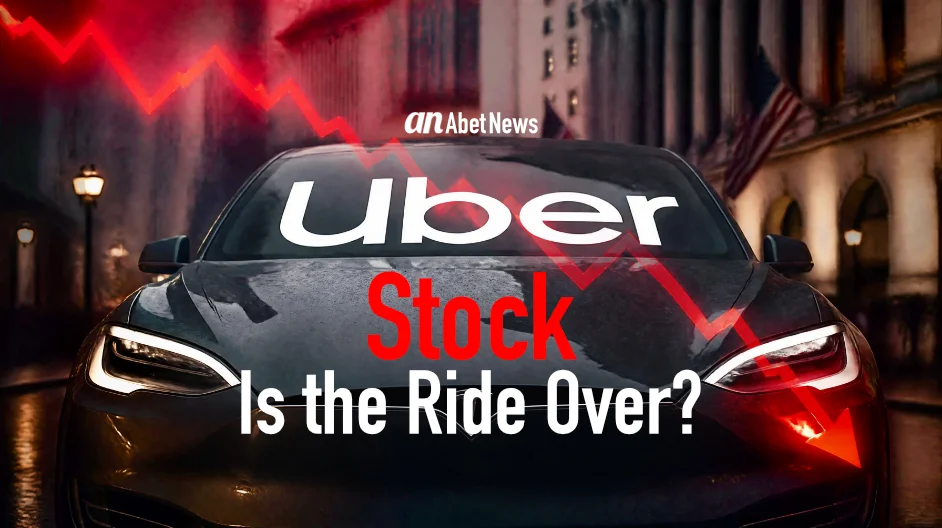
Uber says it is growing. Riders say they are paying more. Drivers say they are getting squeezed. And autonomous vehicles could eventually eliminate the very drivers Uber depends on today.
ABET NEWS | EDITORIAL – MARKETS | OCTOBER 1, 2026
Uber has a strange story to tell investors.
The company says its platform is stronger than ever.
But if we look beyond the corporate earnings presentation, another story begins to emerge.
Are riders paying more?
Are drivers receiving less?
Are drivers becoming less willing to accept Uber trips?
Is Uber’s improving profitability coming partly from taking a larger share of every ride?
And perhaps the biggest question of all:
What happens to Uber when the driver disappears?
Is Uber really growing — and what does “growth” mean?
Uber’s latest financial results certainly show growth.
In the second quarter of 2026, Uber reported 3.9 billion trips, up 18% year over year. Gross bookings increased 24% to $58 billion, revenue increased 12% to $14.2 billion, and adjusted EBITDA increased 33% to $2.8 billion. Uber also reported $2.8 billion in quarterly free cash flow and said trailing-12-month free cash flow had exceeded $10 billion for the first time. (Uber Investor Relations)
So the question isn’t whether Uber’s reported numbers are growing.
They are.
The more important question is:
What is driving that growth?
Are more customers and more trips producing more value for everyone in the Uber ecosystem?
Or is Uber increasingly generating more revenue by charging riders more while giving drivers a smaller share of the transaction?
That question became considerably more interesting this week.
Are riders paying more while drivers are receiving less?
A September 2026 analysis by Columbia Business School adjunct professor Len Sherman examined 37,500 Uber rides across six U.S. cities.
The study reported that between the first quarter of 2023 and the first quarter of 2026, the average cost per mile increased 53%, while the time between driver matching and pickup increased 19%.
Sherman attributed the pattern to Uber’s effort to become more profitable by charging riders more and paying drivers less.
Uber disputed the findings and pointed to earlier company statements challenging similar conclusions. (Business Insider)
That distinction is important.
The study does not prove that Uber deliberately manipulates every customer’s fare or that every driver is being paid less.
But it raises a question that investors should not ignore:
If Uber can increase the amount a rider pays while reducing the amount going to the driver, how much of Uber’s improving profitability is coming from creating new value — and how much is coming from taking a larger share of existing value?
That is a very different question from simply asking whether Uber’s revenue is increasing.
What are drivers seeing from behind the wheel?
Uber’s financial statements measure trips, bookings, revenue and profits.
Drivers experience something else.
They see individual offers.
They see how many miles they have to drive to pick someone up.
They see how much time the trip takes.
They see what Uber says the passenger is paying.
And they decide whether the trip is worth accepting.
That creates a critical distinction.
Uber can report that trips are increasing while individual drivers can simultaneously feel that the economics of accepting those trips are getting worse.
Those two things can exist at the same time.
And if enough drivers reach the same conclusion, the consequences can eventually become visible to riders.
Longer waits.
Fewer available drivers.
More rejected trips.
Drivers moving between platforms.
Drivers choosing Lyft when a particular trip appears more attractive.
Or drivers simply deciding that some Uber trips aren’t worth accepting.
There is no single driver experience across the United States, and anecdotal driver discussions cannot establish a nationwide migration from Uber to Lyft.
But the underlying economic question is real:
How much can Uber squeeze the supply side of its marketplace before drivers stop supplying enough rides?
And what happens when riders start noticing?
This may be even more important.
Consumers don’t necessarily care about Uber’s adjusted EBITDA.
They care about the price appearing on their phone.
A June 2026 Consumer Reports investigation found substantial differences between prices quoted to different customers for comparable Uber and Lyft trips checked within minutes of one another. Consumer Reports reported a median difference of 42.4% between its lowest and highest price groupings across the routes it tested.
Uber and Lyft disputed aspects of the methodology and the interpretation of their pricing systems.
The important issue isn’t whether every difference should be called “price manipulation.”
The important issue is trust.
When a rider sees one price and another rider sees something dramatically different for what appears to be the same journey, the natural question is:
Why?
And once riders begin questioning the algorithm, they may start looking for alternatives.

Some things cannot be automated. A kind word. A warm embrace. A healing touch.
Effusion – Healing Touch Remix, featuring Tamar (Clean)
What happens when riders and drivers start comparing notes?
This may be Uber’s most uncomfortable problem.
Imagine a rider looking at a $60 fare.
Then imagine the driver looking at the amount offered for that same trip.
The rider may ask:
“How much of my $60 are you actually getting?”
The driver may ask:
“How much is the passenger actually paying?”
And eventually another question can appear:
Why don’t we simply deal with each other directly?
Uber explicitly prohibits drivers from soliciting off-platform rides and instructs riders to report drivers who request cash or other payment outside the app.
That doesn’t mean riders and drivers are widely abandoning Uber.
It does mean Uber has a very obvious structural vulnerability:
It is the middleman.
And the more both sides believe the middleman is taking too much, the more attractive bypassing the middleman can appear.
That is not an Uber-specific phenomenon.
It is the fundamental risk faced by every marketplace platform.
Could Uber’s success actually create its own problem?
Uber’s business model depends on two groups remaining happy enough to participate:
Riders need affordable and reliable transportation.
Drivers need compensation that makes accepting trips worthwhile.
Uber sits in the middle.
If Uber increases prices too aggressively, riders can leave.
If Uber reduces driver compensation too aggressively, drivers can leave.
If Uber takes too much from both sides, both groups can become frustrated at the same time.
And unlike the early days of Uber, consumers now have alternatives.
Lyft.
Public transportation.
Traditional taxis.
Car ownership.
And increasingly:
autonomous vehicles.
Then the driver disappears
This is where Uber’s long-term strategy becomes fascinating.
Uber is aggressively preparing for autonomous transportation.
The company says autonomous vehicles are already operating on its platform in seven cities and that it is on track for as many as 15 cities by the end of 2026.
Uber also says its autonomous partners have committed approximately 120,000 vehicles to its network over the coming years. (Uber Investor Relations)
Uber is working with more than 30 autonomous-vehicle partners and has announced partnerships involving companies including Wayve, WeRide, Nuro, Zoox, NVIDIA, Rivian and Volkswagen’s MOIA America.
In other words:
Uber is preparing for a world in which the driver is no longer necessary.
But that creates a remarkable contradiction.
Uber needs drivers today.
Yet Uber’s long-term strategy could reduce its dependence on them.
Is Uber becoming the marketplace — or becoming unnecessary?
Uber’s strategy is straightforward:
It doesn’t necessarily need to manufacture the autonomous vehicle.
It wants to provide the marketplace.
The rider opens Uber.
The vehicle arrives.
The autonomous technology belongs to someone else.
The vehicle may belong to someone else.
Uber provides the platform connecting them.
That could be enormously valuable.
But there is another possibility.
What happens if Waymo decides it can provide the vehicle, autonomous technology, transportation service and customer relationship itself?
Waymo already operates its own autonomous ride-hailing service.
And something happened this year that should get investors’ attention.
Uber and Waymo already went separate ways in Phoenix
In June 2026, Uber and Waymo ended their autonomous-vehicle partnership in Phoenix.
The Waymo vehicles that had been operating through Uber were returned to Waymo’s own fleet, which continued operating through Waymo’s own app.
Waymo’s vehicles remain available through Uber in Austin and Atlanta, but the Phoenix development demonstrates that the relationship between an autonomous company and Uber isn’t necessarily permanent.
Then, in July, Reuters reported that Waymo was exploring ending its Uber partnership in additional markets because of disagreements over operational and financial issues. Reuters noted that the report was based on a Financial Times report and had not been independently verified; neither company publicly confirmed the report at the time.
That doesn’t prove Waymo will abandon Uber.
But it raises an extraordinary question:
How long does the world’s leading autonomous ride-hailing company actually need Uber?
Google doesn’t need Uber forever
This may be the central issue.
Waymo is owned by Alphabet, Google’s parent company.
Alphabet has enormous resources in artificial intelligence, mapping, cloud infrastructure, computing and autonomous-driving technology.
If Waymo can eventually operate a sufficiently large autonomous transportation network directly with consumers, why would it permanently need another company’s marketplace?
Perhaps Uber will remain valuable because it provides millions of customers.
Perhaps Uber’s scale will make it cheaper for autonomous fleets to use Uber than to build their own marketplace.
Or perhaps autonomous companies will eventually decide that owning the entire customer relationship is more valuable.
We don’t know.
But Uber’s future depends heavily on the answer.
Uber is betting on being the “middleman” of autonomy
Uber’s response is to become bigger in autonomous transportation, not smaller.
The company has announced an agreement with NVIDIA to bring software-driven autonomous vehicles to Uber’s network, with plans to start in Los Angeles and San Francisco and eventually expand to 28 cities by 2028.
Uber and Rivian have announced plans for up to 50,000 autonomous robotaxis, with initial deployments expected in San Francisco and Miami beginning in 2028.
And in Los Angeles, Volkswagen’s MOIA America is preparing autonomous ID. Buzz vehicles for the Uber platform, with rides planned for late 2026.
Uber clearly sees itself as the platform connecting autonomous fleets with passengers.
The question is whether the autonomous companies will always agree.
The DiDi warning
There is another reason to be cautious about assuming today’s ride-hailing leaders will automatically dominate tomorrow.
DiDi Global’s U.S. IPO was priced at $14 per ADS in June 2021.
Following regulatory action in China, DiDi was delisted from the New York Stock Exchange and its securities later traded over the counter.
DIDIY now trades at a fraction of its IPO price.
But DiDi should not be used as proof that Uber will follow the same path.
The regulatory circumstances were dramatically different.
The lesson is more basic:
A rapidly growing ride-hailing company can look very different to investors when the regulatory, technological or competitive environment changes.
So, is Uber’s profitability sustainable?
This is where the Uber investment story becomes uncomfortable.
Uber can report:
More trips.
More bookings.
More revenue.
More EBITDA.
More free cash flow.
And all of those numbers can be real.
But investors should still ask:
Are these improvements coming from a larger, healthier marketplace — or from Uber taking a larger share of the money flowing through the marketplace?
If Uber charges riders more while drivers receive less, the company can potentially improve its financial results.
But can that strategy continue indefinitely?
What happens if drivers refuse more trips?
What happens if riders begin switching platforms?
What happens if passengers become more comfortable comparing Uber and Lyft prices before every trip?
What happens if riders and drivers increasingly question whether Uber is worth its share of the transaction?
And what happens when autonomous vehicles remove the driver entirely?
The real Uber question isn’t $60 or $100
This is why the stock price alone may be distracting us from the bigger story.
The question isn’t simply:
Will Uber return to $100?
Or:
Will Uber fall to $60?
And it isn’t even:
Is Uber making money?
Clearly, Uber is.
The more important questions are:
How durable is Uber’s relationship with its riders?
How durable is Uber’s relationship with its drivers?
How much can Uber increase its take before the marketplace begins pushing back?
And when autonomous vehicles become the dominant form of ride-hailing, will the companies that own those vehicles still need Uber?
When the driver disappears, what exactly is Uber worth?
This may be the most important question of all.
Today, Uber’s enormous driver network is one of its greatest assets.
Tomorrow, autonomous vehicles could make that network far less important.
Uber is betting that its platform will become the bridge between riders and autonomous fleets.
But what happens if those autonomous fleets eventually decide they don’t need the bridge?
Waymo already has its own app.
Waymo already operates its own autonomous fleet.
Waymo already has its own autonomous-driving technology.
And Alphabet has the financial and technological resources to continue building the ecosystem.
Uber may become the neutral marketplace where autonomous companies compete.
Or the autonomous companies may eventually decide they would rather own the customer themselves.
Nobody knows yet.
But that uncertainty is precisely why Uber’s impressive financial numbers deserve another question:
Is Uber creating a transportation platform that becomes more valuable as autonomy arrives — or is it maximizing today’s marketplace while its long-term role becomes less certain?
The ride isn’t necessarily over.
But the road ahead is changing.
And for Uber investors, drivers and riders alike, the destination may matter more than today’s fare.
Tracy Goodman
© 2026 Abet News. All rights reserved.
Related Post

Apple TV+

JMI Construction