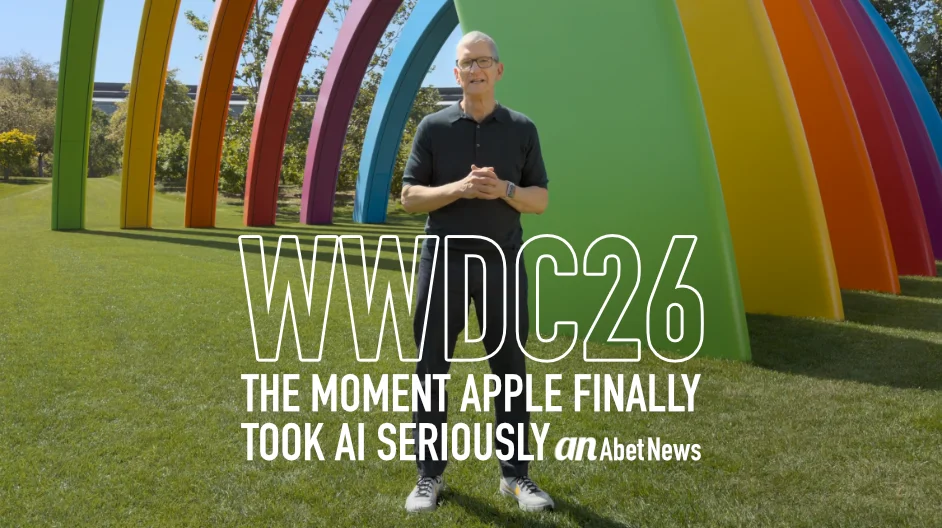
WWDC26: The Moment Apple Finally Took AI Seriously
ABET NEWS · AI TECH · JUNE 8, 2026
For years, Apple has been one of the most successful technology companies in the world. It revolutionized personal computing, reinvented the smartphone, transformed the tablet market, and built one of the most profitable ecosystems ever created.
Yet as the artificial intelligence revolution accelerated, many began asking an uncomfortable question:
Was Apple falling behind?
While competitors such as Google, Microsoft, OpenAI, and a growing number of Chinese technology companies raced ahead with increasingly capable AI systems, Apple appeared cautious, deliberate, and at times surprisingly absent from the conversation.
WWDC26 may have changed that.
The annual Worldwide Developers Conference did not introduce a new iPhone. It did not unveil a revolutionary hardware category. It did not produce a dramatic “one more thing” moment reminiscent of Steve Jobs-era keynotes.
Instead, WWDC26 delivered something Apple arguably needed more than a new gadget:
A clear AI strategy.
From Observer to Participant
For much of the AI boom, Apple found itself in an unfamiliar position.
The company that once defined the future of consumer technology was increasingly viewed as reacting to industry trends rather than setting them.
Google pushed forward with Gemini.
Microsoft embedded AI throughout Windows and its productivity software.
OpenAI turned ChatGPT into a household name.
Meanwhile, Apple’s AI efforts often felt fragmented, cautious, and difficult for consumers to understand.
That perception became a growing concern for investors, developers, and Apple fans alike.
WWDC26 addressed those concerns directly.
Throughout the keynote, Apple made one thing clear: artificial intelligence is no longer a side project or experimental feature. It is becoming a central pillar of the iPhone, iPad, Mac, and the broader Apple ecosystem.
The message was unmistakable.
Apple is no longer watching the AI race from the sidelines.
It intends to compete.
Siri Finally Grows Up
Perhaps the most important announcement of WWDC26 was the evolution of Siri.
For years, Siri struggled to keep pace with modern AI assistants. While competitors became more conversational, more context-aware, and more capable of handling complex requests, Siri often felt limited to simple commands and predefined actions.
The gap became increasingly difficult to ignore.
At WWDC26, Apple presented a vision for Siri that feels much closer to what users have been expecting all along.
The new Siri AI promises deeper contextual understanding, improved awareness of on-screen content, more natural conversations, and the ability to complete more sophisticated tasks across applications.
If Apple delivers on these promises, Siri could finally become the intelligent assistant users imagined when voice assistants first entered the mainstream.
That alone makes WWDC26 significant.
A Different Kind of Apple
Perhaps the most surprising aspect of WWDC26 was Apple’s apparent willingness to embrace a more pragmatic approach to artificial intelligence.
Historically, Apple preferred to build key technologies internally and maintain tight control over the user experience.
This strategy has produced some of the company’s greatest successes.
However, the rapid pace of AI development may require a different mindset.
Rather than insisting on building every component from scratch, Apple appears increasingly willing to collaborate, integrate, and leverage the best technologies available while maintaining its privacy-focused philosophy.
This may not be the most glamorous strategy, but it could prove to be the smartest.
Consumers care less about who created a technology and more about whether it works.
If Apple can combine industry-leading AI capabilities with the simplicity, security, and ecosystem integration that customers expect, it may discover that arriving later is not necessarily a disadvantage.
The Real Story Isn’t AI
Ironically, the most important takeaway from WWDC26 may not be artificial intelligence itself.
It may be confidence.
Over the past several years, Apple faced growing criticism regarding innovation. Some questioned whether the company still possessed the ability to define the next era of technology.
The rise of generative AI intensified those concerns.
WWDC26 did not answer every question, but it demonstrated that Apple understands the challenge.
More importantly, it showed that Apple has a plan.
For developers, investors, and customers, that matters.
Technology companies do not succeed merely because they have the most advanced features. They succeed because they create ecosystems, inspire confidence, and provide a vision of where technology is heading.
WWDC26 provided that vision.
The Competition Is Not Standing Still
Of course, Apple’s challenges are far from over.
Google continues to move aggressively with AI.
Microsoft remains deeply invested in integrating AI across its software ecosystem.
OpenAI continues to expand the capabilities of conversational AI.
Chinese technology companies are rapidly developing their own AI ecosystems and hardware platforms.
The competition Apple faces today may be more intense than at any point in the smartphone era.
That reality means execution will matter far more than keynote presentations.
Consumers will ultimately judge Siri AI based on real-world performance, not demonstrations.
Developers will judge Apple based on the tools they receive and the opportunities they can create.
Investors will judge Apple based on adoption, engagement, and long-term growth.
WWDC26 was an important first step.
The next twelve months will determine whether it was also a turning point.
YouTube: Apple WWDC 2026 June 8: Introducing Siri AI and more
Why This WWDC Matters
Not every important event in technology is revolutionary.
Some are foundational.
Some establish a direction.
Some mark the moment when a company recognizes that the future has changed and chooses to adapt.
WWDC26 feels like one of those moments.
Apple did not reinvent the smartphone.
It did not unveil a product destined to change the world overnight.
Instead, it did something arguably more important.
It acknowledged that artificial intelligence will define the next generation of computing and demonstrated that Apple intends to be part of that future.
Whether the company succeeds remains to be seen.
But for the first time in years, Apple’s AI story feels coherent, ambitious, and believable.
That may ultimately be the most important announcement of WWDC26.
Because after years of cautious steps and unanswered questions, WWDC26 felt like the moment Apple finally took AI seriously.
Andy Young
© 2026 Abet News. All rights reserved.
Related Posts


Apple TV+
JMI Construction