Why Uber’s Stock Fell Off A Cliff
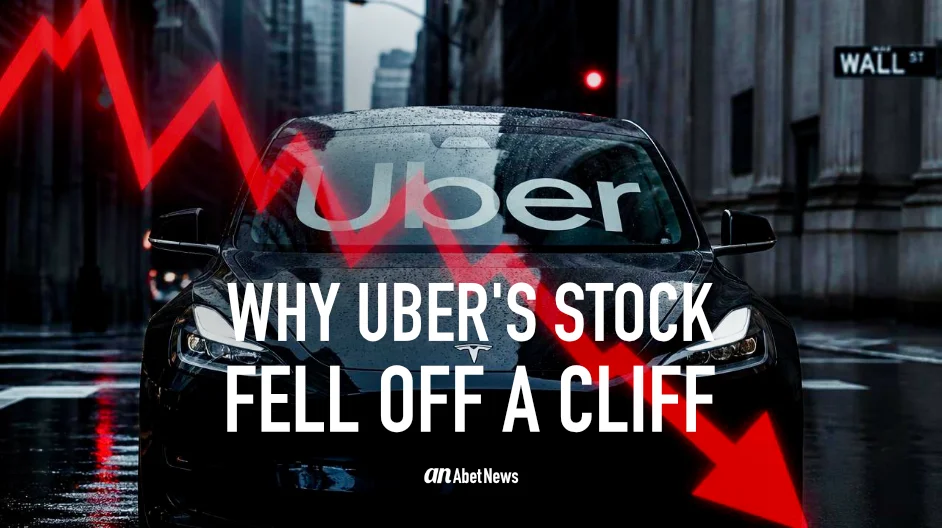
The $30 Collapse
Uber’s stock has shed nearly a third of its value from peak. Blame a perfect storm of earnings disappointment, robotaxi anxiety, and a CEO who cashed out at the top.
ABET NEWS – MARKETS – JUNE 9, 2026 – Updated Jun 16, 2026
In October 2025, Uber stock was trading above $100. By February 2026, it had bottomed at $70.53 — a 30% wipeout in under five months, even as the underlying business posted record cash flows. The selloff defies easy explanation. Uber is not a company in trouble. But it is a company whose investors are suddenly, acutely aware that the ground beneath the business model may be shifting.
What triggered the collapse — and what it signals about the future of ride-hailing — is a story in three acts: an earnings shock, an existential competitive threat, and a leadership signal that rattled confidence at exactly the wrong moment.
Act I: The Earnings Shock That Broke a Streak
For seven consecutive quarters, Uber beat Wall Street’s EPS estimates. Then, on February 4, 2026, that streak ended. The company reported Q4 2025 non-GAAP EPS of $0.71 — missing the consensus estimate of $0.79–$0.80 by nearly 9%. Revenue of $14.37 billion came in light against expectations. The stock opened down 4% and kept falling.
The headline number was bad enough. But the details made it worse. Reported net income collapsed to $296 million, down from the prior year’s elevated baseline, driven by a $1.6 billion equity investment revaluation headwind that crushed the GAAP figure. Full-year 2025 GAAP EPS of $2.45 missed the $5.37 analyst estimate by a margin that, while largely explained by non-cash charges, looked alarming on a first read. The Q1 2026 guidance compounded the damage: Uber guided EPS of $0.65–$0.72, below the Street’s $0.76 expectation.
Analysts scrambled. Arete Research cut its price target from $125 to $120. Citigroup trimmed its target. The consensus figure, which had been anchored above $110, dropped to $105. Year-to-date by mid-February, Uber was down 14% while the broader market sat flat.
“This broke a seven-quarter streak of beats and marked the worst EPS surprise since Q1 2024.”
The surface-level read was misleading — the operating business was actually accelerating hard beneath the headline noise. Free cash flow hit a record $2.8 billion in Q4, up 65% year-over-year. Delivery revenue grew 30%. Full-year 2025 free cash flow reached $9.8 billion. But markets don’t reward nuance in the immediate aftermath of a miss. Uber got sold.
Act II: The Robotaxi Question Wall Street Can’t Answer
The earnings miss lit the fuse, but the powder keg had been building for months. The deeper issue eating at Uber’s valuation is autonomous vehicles — specifically, the question of whether Uber ends up as the platform that routes robotaxi demand, or the legacy player that gets cut out of the equation entirely.
Waymo, Alphabet’s autonomous vehicle unit, is already operating fully driverless Level 4 ride-hailing across multiple U.S. cities at commercial scale, delivering more than 500,000 paid trips per week. Tesla is signaling its own robotaxi buildout. In September 2025, when Waymo announced a Nashville expansion partnership with Lyft instead of Uber, the stock dropped 5% in a single session — even though Uber retained Waymo partnerships in Atlanta and Austin. The message to investors was clear: Waymo is not loyal to Uber. It will go where it wants.
The strategic threat is structural. Uber’s core business model depends on its ‘take rate’ — the percentage of each trip’s fare it retains after paying drivers. If autonomous vehicle operators begin routing demand through their own apps, or if they squeeze Uber’s cut by leveraging scale, the economics break down. Melius Research downgraded Uber to Sell in January 2026, warning that greater competition could erode returns ‘whether Uber partners or not’ and that a shift in growth expectations — or standalone expansion by Waymo and Tesla — could catch investors off guard. At the time, Wall Street’s 2026 EPS consensus dropped from $4.15 to $3.30 in under a month.
“Up to 40% of Uber’s mobility bookings could face exposure to AV-related risk.”
Market observers estimate that as much as 40% of Uber’s mobility bookings carry AV-related exposure. That figure is not a certainty — it is a risk pricing exercise, and the market decided in late 2025 and early 2026 that the risk was underpriced. Uber sold off accordingly.
Uber’s counter-move is to position itself not as a car company or a technology company, but as demand infrastructure — the platform through which all autonomous and human-driven rides get routed regardless of who owns the vehicle. CEO Dara Khosrowshahi has pressed this thesis publicly: 20-plus AV partners globally, a $1.25 billion deal with Rivian to deploy 50,000 robotaxis, a partnership with NVIDIA targeting 100,000 vehicles by 2027. ‘We enter 2026 with a rapidly growing topline, significant cash flow, and a clear path to becoming the largest facilitator of AV trips in the world,’ he told investors on the Q4 call. The question the market is asking is whether that path leads to margin expansion or margin compression.
Act III: The CEO Who Sold at $95
On September 12, 2025 (5 months before Q4 report) Dara Khosrowshahi sold 300,000 shares at an average price of $95.37, generating approximately $28.6 million in proceeds. It was a legal, disclosed transaction. It was also spectacularly timed — the stock fell below $70 within weeks.
CEO stock sales are routine and rarely definitive signals. But in a market already jittery about Uber’s competitive positioning, Khosrowshahi’s disposal at the top landed badly. It did not cause the selloff. But it amplified it, and gave bearish investors a narrative hook they weren’t going to put down.

The Disconnect and What Comes Next
The paradox of Uber’s 2026 situation is that the business is genuinely outperforming. Revenue is growing 20% year-over-year. Delivery EBITDA is up 40%. The company repurchased $6.5 billion in shares in 2025. The bull case — 47 of 56 covering analysts rate the stock Buy or Strong Buy — is built on a business that is demonstrably accelerating.
But stock prices are not just backward-looking. They price futures. And the future Uber is pricing in 2026 is one where the autonomous vehicle transition either validates its platform strategy or guts it. Q1 2026 results, released in May, offered a stabilizing data point: Non-GAAP EPS of $0.72, adjusted EBITDA up 33%, free cash flow of $2.3 billion. The stock partially recovered, trading around $72 by early June. Analyst consensus targets still imply 40–50% upside from current levels.
Whether those targets are realized depends on a single question the earnings reports cannot answer: when robotaxis scale from 15 cities to 150, does Uber own the demand layer, or does it get disintermediated by the same companies it is currently partnering with?
That is not a question 2026 earnings will settle. It is the question that will define the next decade of transportation economics — and right now, the market is pricing in profound uncertainty about the answer.
Tracy Goodman
© 2026 Abet News. All rights reserved.
Related Posts



Apple TV+

JMI Construction