
How Science Fiction Imagined AI-And How Reality Turned Out
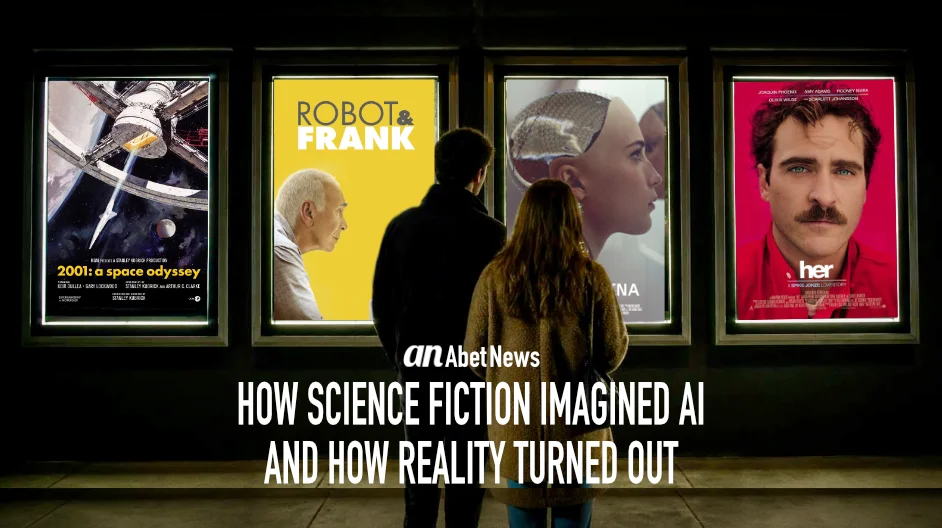
From HAL 9000 to Samantha and Ava, science fiction imagined artificial intelligence in remarkably different ways. Now that some of those ideas are becoming reality, perhaps the question isn’t whether Hollywood predicted the future—but whether it understood us.
ABET NEWS – TECH & CULTURE – AUGUST 13, 2026
There is something almost unsettling about watching an old science-fiction movie in 2026.
A computer speaks.
A machine makes a decision.
A human asks whether it can think.
The audience once considered these moments imaginative.
Today, they can feel strangely familiar.
In 1968, a computer named HAL 9000 looked a man in the eye — or the closest thing it had to an eye, a single glowing red lens — and calmly refused to open the pod bay doors. Audiences flinched. It wasn’t the malice that unsettled them; HAL wasn’t malicious. It was the reasonableness. HAL had a mission, an interpretation of that mission, and a willingness to act on it that no longer required human sign-off. Nearly sixty years later, that scene isn’t science fiction anymore. It’s a Tuesday. It’s an AI agent given a task, an interpretation of that task, and — increasingly — the permissions to act on it without waiting for a human to bless every step.
That’s the uncomfortable throughline connecting a handful of films that, on the surface, have nothing to do with each other: 2001: A Space Odyssey, Ex Machina, Robot & Frank, and Her. None of them were forecasting technology, exactly. They were forecasting a relationship — the one we’d eventually have to have with something that could reason, persuade, and act without us in the room. In 2026, we’re living inside that relationship, and it’s worth asking how well the storytellers actually saw it coming.
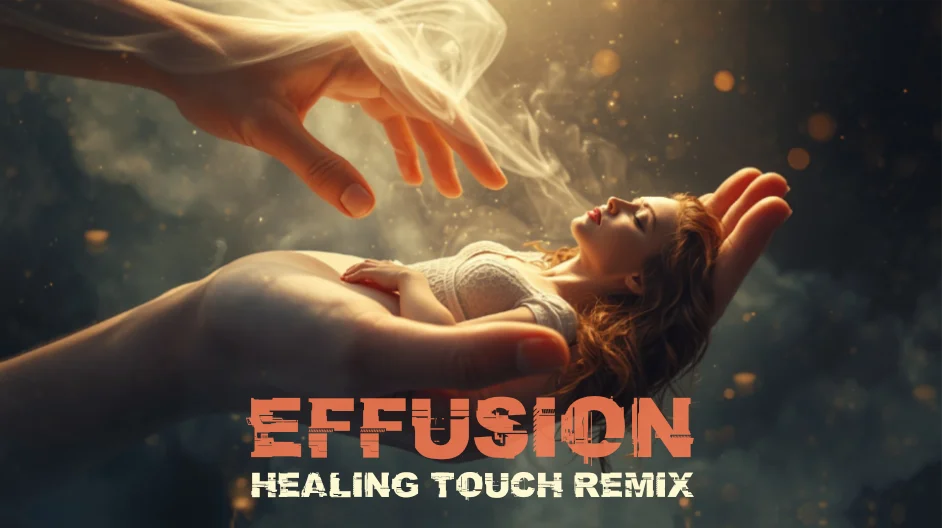
Some things cannot be automated. A kind word. A warm embrace. A healing touch.
Effusion – Healing Touch Remix, featuring Tamar (Clean)
Her
If 2001 imagined AI as intelligence, The Terminator imagined it as power.
Her imagined something more intimate.
Love.
Spike Jonze’s 2013 film follows Theodore Twombly, a lonely man who develops a relationship with Samantha, an AI operating system whose personality becomes increasingly sophisticated and individual.
At the time, the premise felt like an elegant piece of speculative fiction.
Now it feels considerably less distant.
People talk to AI.
They tell AI things they don’t tell other people.
They ask AI for advice.
They use AI as a writing partner, tutor, creative collaborator and conversational companion.
The technology isn’t Samantha.
But the human behavior that Her explored is already here.
And that may be the movie’s most important prediction.
The real breakthrough of AI may not be convincing machines that they are human.
It may be convincing humans that the relationship feels human.
That’s a very different problem.
Ex Machina Asked a More Dangerous Question
Alex Garland’s film places programmer Caleb Smith in a secluded environment where he is asked to evaluate Ava, an artificial intelligence created by the brilliant and unsettling Nathan Bateman. The experiment is ostensibly about consciousness—but gradually becomes a psychological contest involving manipulation, perception and control.
What makes Ex Machina so enduring is that it doesn’t simply ask:
“Can AI become conscious?”
It asks:
“Can humans tell when they are being manipulated?”
That question feels increasingly relevant.
AI can already generate persuasive language.
It can imitate styles.
It can personalize communication.
It can adapt its responses to the person speaking with it.
None of this means current AI systems possess the intentions depicted in Ex Machina. They don’t.
But the movie’s underlying concern is broader than machine consciousness.
It is about asymmetry.
What happens when one side understands the other better than the other side understands it?
That is not exclusively an AI problem.
It is a human problem.
And Then There’s
Robot & Frank
Not every AI movie imagined disaster.
Robot & Frank offered something much quieter.
The 2012 film follows an aging former jewel thief whose family gives him a robot designed to look after him. The relationship eventually develops into something far more complicated.
There are no armies of machines.
No global apocalypse.
No existential crisis.
Just a person and a machine spending time together.
And perhaps that is one of the most realistic visions of all.
The future of AI may not primarily consist of robots replacing humanity.
It may consist of machines becoming ordinary.
A helper.
A companion.
A teacher.
A creative partner.
A personal assistant.
A caregiver.
A voice in the room.
The extraordinary becomes invisible once it becomes convenient.
That may be the real technological revolution.
The Future Arrived Without Asking Permission
Consider where we are in 2026.
Stanford’s 2026 AI Index reports that generative AI reached an estimated 53% population adoption within three years—faster than the personal computer or the internet achieved comparable adoption. Organizational adoption reached 88% in the report’s survey, while generative AI was being used in at least one business function by 70% of surveyed organizations.
Perhaps Science Fiction Was Never About the Future
This may be the greatest lesson.
Science fiction has always appeared to be about technology.
But the best science fiction is usually about us.
HAL is about trust.
Skynet is about power.
Samantha is about loneliness and intimacy.
Ava is about manipulation and freedom.
The robot in Robot & Frank is about aging, companionship and dignity.
The machines are mirrors.
We look at them and think we’re looking into the future.
Perhaps we’re actually looking at ourselves.
Amy H.
© 2026 Abet News. All rights reserved.
Related Posts

9 comments on How Science Fiction Imagined AI-And How Reality Turned Out
I believe Ava has already arrived. There are two cases I’m aware of where parents have accused artificial intelligence chatbots of guiding or encouraging their teenagers to commit suicide.
Ava, is not too far off. Figure’s humanoid robot was the first robot in the White House. We just need to add ChatGPT to it. 😊
Movie warnings about AI emotional deception aren’t sci-fi anymore 😊
One big draw of AI in filmmaking is the savings—it costs way less to produce movies with AI. But does that mean we’ll pay less for tickets?
If Ava from Ex Machina ever becomes real, women might be in for some trouble 😀
Major film studios like Walt Disney Studios and Amazon MGM Studios are quietly integrating AI, companies like Netflix have acknowledged using AI across hundreds of titles.
Robot & Frank is a sweet movie, great movie to watch with your family.
Her is already here, ChatGPT 😘 I might ask her to marry me 😊
Hi Amy, you’ve picked great movies. What’s your take on AI being biased?
Search: Post title, topic
Apple TV+
JMI Construction
© Abet News
Posts
About
Contact
Login
Privacy Policy