
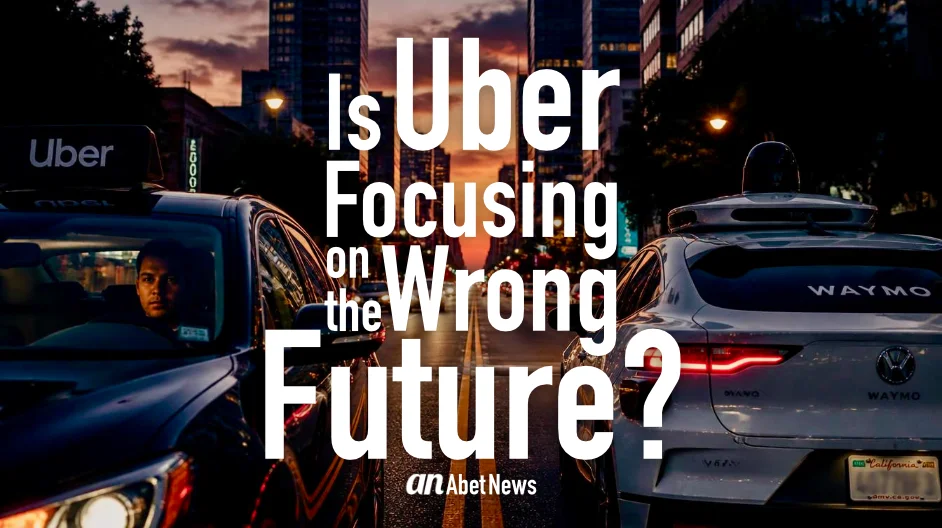
Is Uber Focusing on the Wrong Future?
ABET NEWS | Business & Technology | OCTOBER 15, 2026
Uber’s future may depend less on replacing drivers than on giving them a reason to stay.
Uber has spent years positioning itself at the center of the future of transportation. Autonomous vehicles are becoming a reality, and partnerships with companies developing self-driving technology offer a potential path to growth.
But is Uber paying enough attention to the people who built its business?
Our investigation raises a different question: What if Uber’s greatest opportunity isn’t replacing human drivers, but building a better relationship with them?

Every Destination Has A Story. Sometimes That Story Becomes Music.
What Do Riders Really Think About Robotaxis?
We asked Uber and Lyft drivers to do something simple when they spotted a Waymo vehicle on the road: ask their passengers whether they had tried a driverless ride and, if so, what they thought of the experience.
According to the informal feedback collected from over 300 riders in our investigation, 99% of riders who had tried a Waymo said they preferred human drivers. The remaining respondents said they would never try a driverless vehicle.
These conversations are not a representative survey of all rideshare passengers. However, they raise an important question that deserves a closer look.
Is the transportation industry paying enough attention to what passengers actually want?
A ride is not always just a journey from point A to point B. For some passengers, it is an opportunity to have a conversation, ask for assistance, or feel more comfortable knowing another person is behind the wheel.
Technology companies often measure progress through automation, efficiency, and lower operating costs. But those metrics do not necessarily capture every aspect of the customer experience.
A vehicle can drive itself. That does not automatically mean it can deliver the entire human service that passengers may need.
Uber’s Most Valuable Asset May Be Its Drivers
Consider what Uber’s business model asks of its drivers.
Drivers supply their own vehicles and generally pay for gasoline, insurance, maintenance, repairs, and mobile phone service. They also absorb vehicle depreciation and other costs associated with keeping their cars on the road.
Uber provides the platform connecting drivers with passengers, handles payments, and takes a portion of the fare.
This arrangement has helped Uber expand without having to own and maintain a conventional fleet of cars and employ every driver directly.
But it also raises a fundamental question: What happens when the people providing the service no longer believe the arrangement is worth it?
Drivers need more than access to a smartphone app. They need compensation that reflects their actual expenses, a reasonable return on their time, and a business relationship that recognizes their contribution.
Uber could focus more aggressively on improving driver earnings, providing clearer and more predictable compensation, and developing meaningful long-term benefits for the people who make its service possible.
Better driver retention could mean more experienced drivers, a more consistent customer experience, and a stronger reputation.
Instead, when discussions about the future of transportation focus primarily on automation, an essential part of Uber’s existing business risks being overlooked.
A Robotaxi Cannot Provide Every Human Service
Autonomous vehicles may be useful for many journeys. They may offer convenient transportation, operate without a human driver, and eventually help reduce certain operating costs.
But transportation is not always as simple as opening a car door and getting into the back seat.
An older passenger may need assistance getting into or out of a vehicle. Someone recovering from an injury may need help with a walker or a wheelchair. A traveler may need help loading or unloading heavy suitcases.
Human drivers often provide these services as part of the overall passenger experience, even when they receive no additional compensation for the time and effort involved.
Of course, not every driver can or should be expected to provide physical assistance, and some passengers prefer the independence and privacy of a driverless ride. Accessibility also depends on the vehicle and the service being offered.
Nevertheless, there is a distinction worth recognizing: Driving a passenger is one service. Helping a passenger complete a journey is another.
Autonomous technology may eventually support more of these needs, but the ability to navigate traffic does not, by itself, solve every practical challenge passengers face.
Uber should not overlook that difference as it develops its long-term strategy.

Some things cannot be automated. A kind word. A warm embrace. A healing touch.
Effusion – Healing Touch Remix, featuring Tamar (Clean)
Is Uber Building Its Future Around Partners Who Could Become Competitors?
Uber’s relationship with Waymo deserves particular attention.
Waymo, owned by Alphabet, Google’s parent company, has developed its own autonomous-driving technology and operates its own robotaxi service. Uber, meanwhile, has built a platform connecting passengers with drivers and other transportation providers.
The companies have cooperated, but their interests are not identical.
Uber wants to remain the platform customers use to arrange transportation. Waymo has its own technology, fleet operations, and customer-facing app. As autonomous services expand, both companies have reasons to pursue more control over the customer relationship.
We have already seen a significant change in their partnership.
In June 2026, Uber and Waymo ended their robotaxi partnership in Phoenix. Waymo’s vehicles returned to its own service there, while Uber said it was preparing a separate autonomous-vehicle partnership in the city. Waymo rides remain available through Uber in Austin and Atlanta, according to the companies’ published information.
Sources: Reuters, June 29, 2026; Waymo’s official Uber partnership page.
The Phoenix development illustrates a potential risk for Uber: a technology partner can also operate a competing service and maintain its own direct relationship with passengers.
It does not prove that Waymo intends to abandon Uber everywhere, nor does it mean Uber has lost Austin or Atlanta. But it demonstrates why Uber should consider carefully how much of its long-term strategy depends on outside autonomous-vehicle providers.
Partnerships can accelerate expansion. They can also create dependencies.
And when a partner has the technology, the vehicles, and its own customer channel, Uber must consider what makes its platform indispensable.
The Question Uber Should Be Asking
Autonomous vehicles may become an important part of transportation. Ignoring that possibility would be shortsighted.
But treating automation as the primary measure of progress could be equally shortsighted.
Uber already has something that many technology companies spend years trying to build: a large network of drivers, established relationships with passengers, a recognizable brand, and a platform used to arrange transportation.
What would happen if the company invested as much strategic energy in strengthening that network as it does in preparing for a driverless future?
Imagine a service where drivers receive fairer compensation after expenses, passengers enjoy more consistent service, accessibility needs are better accommodated, and experienced drivers have compelling reasons to remain on the platform.
That would not require Uber to abandon autonomous vehicles. It would require the company to recognize that automation and human service can serve different needs.
Uber itself has described its future as a hybrid marketplace in which autonomous vehicles and human drivers operate alongside one another. The company has also said that autonomous vehicles are currently available only in portions of selected cities.
Source: Uber, Autonomous Vehicles Are Coming to More Cities, May 13, 2026.
The opportunity, then, is not necessarily to choose between drivers and machines. It is to create a business in which each serves the needs it is best equipped to meet.
But that requires treating drivers as a strategic asset, not simply as a supply of vehicles and labor.
Change Your Focus Before It’s Too Late
Uber’s success was built by connecting people who needed rides with people willing to provide them.
That relationship remains the foundation of its traditional rideshare business, even as the company explores new technologies.
The question is whether Uber will strengthen that foundation or allow its attention to drift toward a future in which its current drivers become less central to the business.
The company cannot control how quickly autonomous technology advances, how customers respond to it, or how its technology partners evolve. It can, however, make choices about compensation, driver retention, customer service, and the value it provides to the people who use its platform.
A driver who supplies a vehicle, pays the operating expenses, navigates traffic, and helps a passenger with a difficult journey contributes far more than a car and a few minutes of labor.
That contribution deserves to be recognized in the business model.
Autonomous vehicles may change transportation. They may also create new opportunities for Uber. But technology alone will not guarantee lasting customer loyalty, and a partnership today does not guarantee independence tomorrow.
Uber’s challenge is not simply to prepare for a world without drivers. It is to build a business that drivers, passengers, and technology partners all have a reason to choose.
Change your focus before it’s too late.
Tracy Goodman
© 2026 Abet News. All rights reserved.
Related Posts







One comment on Is Uber Focusing on the Wrong Future?
Wow, that’s total BS. Why aren’t drivers compensated for the extra work of helping riders who need extra help. 😡