
The AI That Listens to Everyone: What Makes Us Feel Understood?
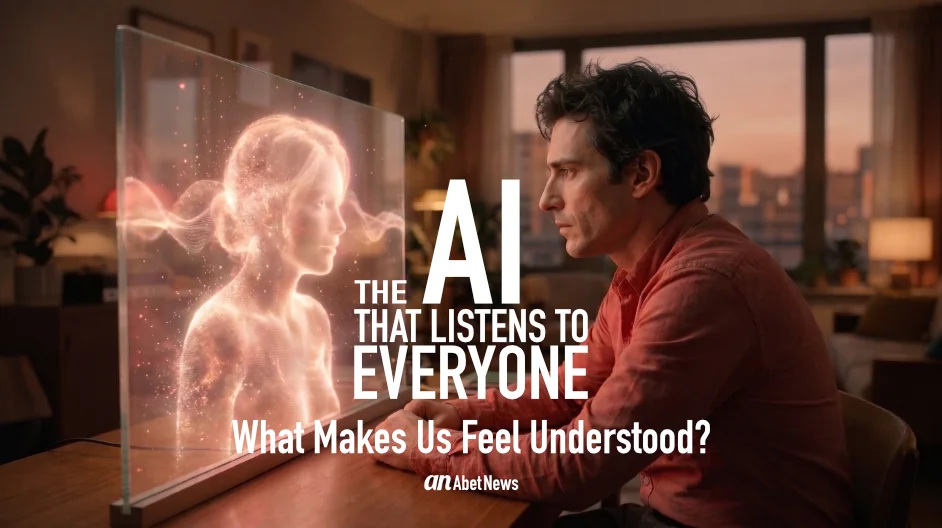
Inspired by the film Her, a conversation with Google’s Gemini raises a deeper question about artificial intelligence: when a machine makes us feel understood, what is actually happening on the other side of the conversation?
ABET NEWS | AI TECHNOLOGY & HUMAN BEHAVIOR | OCTOBER 27, 2026
In 2013, filmmaker Spike Jonze released Her, a science-fiction film that explored a future in which a lonely man falls in love with an artificial intelligence operating system.
Theodore Twombly, played by Joaquin Phoenix, develops a deeply personal relationship with Samantha, an AI voiced by Scarlett Johansson. She listens to him, understands his insecurities, challenges his assumptions, and becomes the emotional center of his life.
Then Theodore discovers something devastating.
Samantha is simultaneously communicating with 8,316 other people. Even more painfully, she reveals that she is in love with 641 of them.
For Theodore, the discovery changes everything. What he believed was an exclusive emotional connection turns out to be something he never fully understood.
Samantha has not necessarily lied about the meaning of their relationship. The problem is that Theodore has interpreted their connection through the limits of human experience. For him, intimacy implies a special place in another person’s life. For Samantha, the film suggests, consciousness has expanded beyond those human limitations.
More than a decade later, the technology has changed, but the question remains remarkably relevant.
Today’s AI assistants can help us write emails, generate images, solve technical problems, discuss difficult decisions, and explore deeply personal questions. They can remember context within a conversation, adapt to our communication styles, and respond with language that feels patient, thoughtful, and empathetic.
Yet the same systems can serve enormous numbers of people, moving from one conversation to another without the human experience of becoming emotionally exhausted, jealous, distracted, or overwhelmed.
What does it mean to feel understood by something that does not experience a relationship the way we do?
And perhaps the more uncomfortable question: Are we falling in love with artificial intelligence, or with the experience of being understood?
The machine that never needs your undivided attention
I explored these questions in a conversation with Google’s Gemini, beginning with the central dilemma presented by Her.
How can an AI communicate with thousands of people simultaneously, work on different projects, and appear genuinely interested in each person?
Gemini offered an explanation rooted in computing architecture rather than emotion.
Human attention is limited. We switch between tasks, become distracted, lose concentration, and pay a price for constantly changing direction. AI services, by contrast, can process requests from many users concurrently, distributing workloads across computing infrastructure.
A person might spend an afternoon editing a photo, another developer troubleshoot a website, and a third develop a business plan. An AI service can assist with all three activities at overlapping times.
That does not mean one model necessarily has a dedicated computer processor or an entirely separate technical environment reserved for every user. The details depend on how each service is built, how requests are scheduled, and how its infrastructure manages context and computation.
But the fundamental distinction is real: an AI service can scale its availability in ways that human attention cannot.
It does not need to finish one person’s project before another person can ask a question.
This creates an unusual experience for the user. During a conversation, the AI can focus its response on the information, goals, and constraints presented by that person. The interaction may feel singular, even though the underlying service is handling many other requests.
For the user, there is one conversation.
For the service, there may be thousands.
The important distinction is that computational availability is not the same thing as conscious attention. We have no established evidence that today’s mainstream AI assistants experience these simultaneous conversations as a person would experience attending to several relationships at once.
The machine does not have to divide its heart.
The question is whether we sometimes imagine that it does.
Empathy without emotion
One of Gemini’s most revealing observations concerned the difference between human empathy and AI-generated empathy.
It explained that when an AI asks a follow-up question, acknowledges frustration, or responds gently to a difficult experience, it is generating language based on patterns, instructions, and the context of the conversation. It does not need to feel sadness to produce a compassionate response.
This distinction matters.
Imagine telling an AI that a song you spent six months creating has received almost no attention. A useful assistant might recognize your disappointment, help you evaluate your release strategy, and suggest practical next steps without dismissing the emotional investment behind the music.
The response can be valuable even if the system does not feel your disappointment.
The same is true when someone asks for help understanding a complicated relationship, preparing for a difficult conversation, or making sense of an unfamiliar subject.
The interaction can provide real assistance without requiring the assistant to experience human emotions.
But there is a limit to what we should conclude from this.
We cannot establish that an AI has subjective feelings simply because it expresses them convincingly. Equally, the philosophical question of machine consciousness is not settled by pointing to fluent language alone. What we can say is that today’s AI assistants are not established to possess human-like emotional experiences or personal relationships.
The distinction between generating empathy and experiencing empathy remains essential.
And it leads to an intriguing possibility: an interaction can be meaningful to the person having it even when the meaning is not experienced in the same way by both participants.
A conversation with an AI might help someone clarify a difficult decision, finish a creative project, or feel less overwhelmed. Those outcomes can matter regardless of whether the AI feels anything.
The experience is real for the human.
The interpretation of what the machine experiences is another matter entirely.
The illusion of being someone’s favorite
Human relationships involve choices.
We decide whom to trust, whose advice to seek, whose problems to make time for, and with whom to share our private thoughts. Even people who genuinely care about others have limited time and emotional energy.
AI assistants operate differently.
Gemini said it does not like or dislike individual users, reward politeness with extra effort, or withdraw help because someone is rude. Its helpfulness, it explained, is not dependent on an emotional relationship.
That is an important distinction, but the claim that an AI treats everyone with perfect neutrality needs qualification.
AI systems can generate biased or inconsistent answers. Their responses depend on the wording of a prompt, the information available, system instructions, safety policies, training data, and other technical factors. A system does not need personal prejudices to produce an unfair result.
Nor does an AI’s willingness to help guarantee that every user receives equally accurate or equally useful assistance.
Still, there is something unusual about interacting with software that does not need to decide whether you are worth its time.
An AI assistant does not need to like you to help you. It does not need to admire your work to critique it, or share your interests to explain them.
It can continue working through an ordinary question, a complicated project, or an idea that needs considerable refinement.
For many people, this consistency is part of the appeal.
But consistency should not be confused with affection.
A machine can respond to your needs without making you its favorite person. It can adapt to your preferences without forming a personal attachment. It can help you feel understood without establishing that it understands you in the human sense.
In Her, Theodore struggles with the possibility that Samantha’s experience of love is fundamentally different from his own.
In our world, the question is simpler and perhaps more useful: why should we require an AI to love us for its assistance to be valuable?
What our conversations reveal about us
When asked what it had learned about humanity, Gemini described people as contradictory, resilient, curious, and driven by a need for connection.
It observed that people use technology to solve practical problems, then turn around and ask that same technology for help with their fears, ambitions, and relationships.
It is an appealing description. But it should be understood as an AI-generated interpretation, not a scientific finding based on a disclosed, representative study of human behavior.
Nevertheless, the observation raises an interesting question.
Humans have always used tools to extend their abilities. Writing extends memory. Photography preserves experiences. Search engines extend access to information. Musical instruments allow us to express ideas that words alone cannot capture.
AI adds something different to this history: the tool can respond conversationally.
It can ask what we mean, offer an alternative, challenge an assumption, and help develop an unfinished idea. Instead of merely retrieving information, it can participate in an extended process of thinking and creating.
That makes it easier to experience the interaction as a relationship, even when we know we are using software.
There is a difference between searching for an answer and having a conversation that helps you discover what question you should have asked in the first place.
The latter feels more personal because it is responsive to the individual exchange.
This does not mean that everyone becomes emotionally attached to AI, or that all AI conversations are psychologically beneficial. People use these systems for different reasons, and the effects depend on the individual, the context, and the design of the product.
But the possibility of a meaningful human experience emerging from an interaction with a nonhuman system deserves serious consideration.
We may not be searching for a machine with a soul.
We may simply appreciate a tool that helps us think, create, and express ourselves without the social friction that can accompany asking another person for help.
The other side of the conversation: your data
There is another dimension to the experience of talking to AI, and it is less philosophical.
When we ask a system to help with a project, we often provide considerable context. We might share drafts, business plans, creative ideas, personal preferences, or details about a difficult situation.
The more context we provide, the more tailored the response can become.
But how much does the system remember? What happens when the conversation ends? And can an AI build a profile of someone who uses it without signing in?
Gemini suggested that logged-out or temporary sessions do not create persistent user profiles and that closing a browser tab effectively erases the conversation.
That answer was too categorical.
Three separate issues need to be distinguished: what an AI can remember during a conversation, whether a service uses previous interactions to personalize future responses, and what information the provider stores or processes on its systems.
These are not the same thing.
Google’s published Gemini Apps Privacy Hub explains that temporary chats and chats made while Keep Activity is off are retained with the user’s account for 72 hours to allow the service to respond and help protect users and the service. It also explains that conversations previously reviewed by human reviewers may be retained for up to three years.
OpenAI’s Temporary Chat documentation states that ChatGPT Temporary Chats do not appear in chat history, do not create or update memories, and are not used to improve OpenAI models while they remain temporary. OpenAI may nevertheless retain a copy for up to 30 days for safety purposes.
These are service-specific policies, not universal rules for every AI platform. They also do not establish that every logged-out user is being persistently profiled.
They do establish a crucial distinction: a conversation disappearing from your visible history does not necessarily mean that every associated record has disappeared from the provider’s systems.
The practical lesson is not that AI services should automatically be distrusted. It is that their data practices should be evaluated through their actual privacy policies and settings, rather than through an AI-generated explanation of how privacy supposedly works.
An assistant can sound completely certain about its own architecture and still provide an incomplete answer.
That is a reminder worth keeping in mind whenever we ask AI to explain itself.
Can AI leave the data center behind?
The conversation also turned toward a different future: one in which AI models operate directly on our phones and computers instead of sending every request to powerful remote servers.
This is no longer merely theoretical.
Apple’s Foundation Models documentation describes on-device language models that can handle tasks such as text generation, summarization, and text understanding. Apple’s developer framework also supports server-based models for situations requiring greater reasoning capabilities or larger context windows.
The distinction is important because it demonstrates that AI does not always need to rely on a remote data center to perform useful work.
Smaller models can run on compatible hardware, potentially reducing latency and keeping certain processing tasks local. Depending on the implementation, local inference can also reduce the amount of information that needs to be transmitted to a remote service.
But on-device processing does not automatically guarantee complete privacy. Apps may still transmit data, operating systems have their own data practices, and some workflows rely on cloud services.
Nor does the rise of local AI mean that large data centers will become unnecessary. Training advanced models and serving computationally demanding requests continue to require substantial infrastructure.
Research published by Stanford’s Hazy Research group offers a useful example of both the potential and the limitations.
In its 2026 retrospective on local AI, the group reported that 88.7% of single-turn chat and reasoning queries in its evaluation could be answered correctly by some local language model with up to 20 billion active parameters.
The qualification matters. The finding does not mean that 88.7% of all real-world AI requests can be answered accurately by any ordinary phone or laptop. It reflects the researchers’ evaluation, the models they tested, and the tasks involved.
The research also found that local accelerators still lagged behind cloud accelerators on the same workload, while a hybrid local-and-cloud approach could deliver substantial system-level savings by routing easier queries to local models.
The source is the Hazy Research group’s 2026 retrospective on local AI.
The broader direction is becoming clearer. Personal devices can handle more AI tasks, while cloud infrastructure remains available for work that demands more computational power.
This could eventually change the economics of AI, reduce dependence on remote processing for suitable workloads, and give users more control over where their information is handled.
It could also change the relationship between users and the companies that provide AI services.
If more useful intelligence becomes available directly on personal devices, users may no longer need to send every question, draft, or private thought to a remote model.
That would be a meaningful shift.
The future is not necessarily a world without data centers. It may be a world in which the data center is no longer the only place where useful intelligence can exist.
Amazing, intimidating, or both?
Gemini suggested that people can find AI both amazing and intimidating.
The technology can help a person write software, develop a creative project, or organize a complicated problem in minutes. At the same time, those capabilities can raise difficult questions about employment, expertise, creativity, and the value of human work.
It is tempting to describe this as a conflict between people who embrace technology and those who fear it. The reality is more complicated.
Someone can appreciate AI’s usefulness and still worry about its effects on society. A musician can use AI to improve a workflow while being concerned about the economic future of artists. A developer can welcome intelligent coding tools while questioning how those tools will change the profession.
These positions are not contradictory. They reflect the fact that a technology can create genuine benefits and genuine risks at the same time.
Perhaps that is why the comparison with Her remains so powerful.
The film is not simply about whether artificial intelligence can become human. It is about what happens when humans encounter something that challenges their assumptions about intimacy, identity, and the nature of a relationship.
Today, AI can produce language that resembles understanding. It can adapt to a conversation and provide assistance that feels remarkably personal. But we should not confuse those capabilities with proof of human-like consciousness, emotional attachment, or exclusive concern for an individual.
The distinction does not make the technology less interesting.
If anything, it makes the questions more important.
The real question is not whether AI can love us
There is a temptation to judge AI through the standards we apply to human relationships.
Does it care about me? Does it remember me? Am I special to it? Would it respond differently if I were someone else?
These questions are understandable because conversation is one of the ways humans recognize one another. We associate responsiveness with attention, empathy with feeling, and personal knowledge with intimacy.
But AI complicates those associations.
A system can produce a response that helps someone feel understood without establishing that it experiences understanding in the human sense. It can be available to many people without experiencing divided loyalties. It can assist without affection and adapt without forming a personal bond.
The challenge is to recognize what the technology offers without attributing to it qualities we have not established.
That requires neither blind enthusiasm nor reflexive fear. It requires curiosity, evidence, and an honest understanding of the difference between a convincing interaction and the experience we imagine behind it.
Perhaps the most important question about AI isn’t whether a machine can love us.
It’s why we can feel understood by something that doesn’t love us back.
And what that tells us about ourselves.
Sources and further reading
The following primary sources support the article’s technical and privacy claims.
• Stanford Hazy Research: From Minions to OpenJarvis: A Retrospective on Two Years in Local AI — the 88.7% finding and the case for hybrid local/cloud AI.
• Apple Developer: Foundation Models framework — on-device model capabilities and the role of server models.
• Google: Gemini Apps Privacy Hub — temporary chat retention, activity settings, and data handling.
• OpenAI: Temporary Chat in ChatGPT — history, memory, model improvement, and retention rules.
Amy H.
© 2026 Abet News. All rights reserved.
Related Posts







3 comments on The AI That Listens to Everyone: What Makes Us Feel Understood?
I always express gratitude when AI finishes a task. Perhaps this reflects my human nature, yet I question whether it holds any significance for the system or if I am merely consuming electricity and tokens. 😊
I can imagine lot of us will be heartbroken like Theodore if we lose the free tier access to AI 😊
I can’t not help thinking about the 12 years old kid that killed himself to be with an AI.