
Spotify Draws a New Line Between AI and Human Music
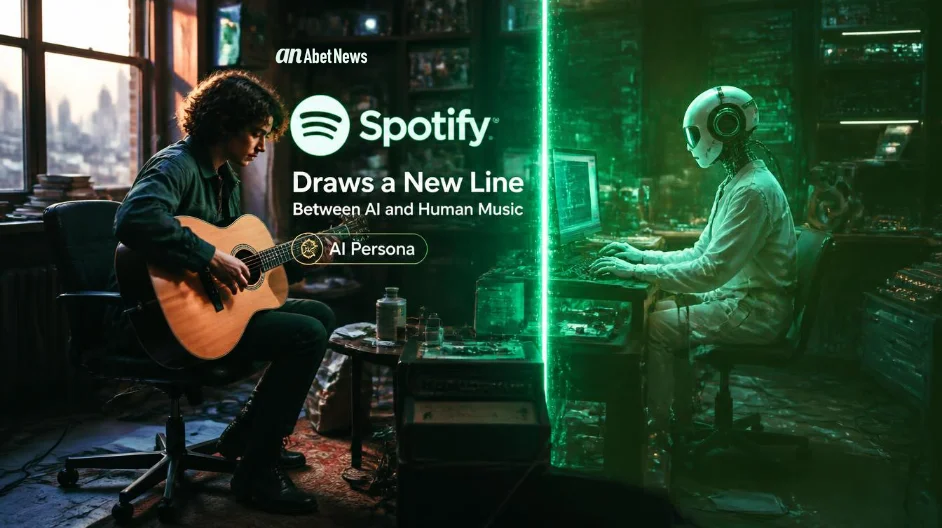
ABET NEWS | EDITORIAL / MUSIC INDUSTRY | AUGUST 15, 2026
There was a time when discovering a new artist meant discovering a person.
Maybe it was someone singing in a basement studio, playing guitar in a small club, uploading songs from a bedroom, or slowly building an audience one listener at a time.
Then streaming changed the economics of music.
Now artificial intelligence is beginning to change something even more fundamental:
What does it mean to be an artist?
Spotify has just drawn a new line.
Beginning in mid-September, the streaming platform will introduce an “AI Persona” badge for certain artist profiles whose public identities appear to be AI-generated. The badge will tell listeners that the identity “may be AI-generated and does not represent a real person.” Spotify says the label will appear on artist profiles, in Search, and on track rows across playlists.
But the most consequential part of the announcement isn’t the badge.
It is what happens to the music afterward.
By default, Spotify says it will exclude AI Personas from its editorial and algorithmic recommendations. If a listener deliberately follows an AI Persona, however, its music can still appear in that listener’s recommendations.
Spotify isn’t banning synthetic artists.
It is doing something potentially more important:
It is refusing to automatically give them the same discovery machinery used to build human music careers.
And that may become one of the defining battles of the AI music era.
Spotify Is Not Saying “AI Music Is Bad”
This distinction matters.
Spotify’s new badge isn’t designed to determine whether a song was made with artificial intelligence.
It is designed to determine whether the artist identity itself appears to be synthetic.
A human musician can use AI during the creative process and still remain a human artist.
Spotify specifically says the AI Persona badge concerns an artist’s public identity—including the name and imagery presented on the profile—not how the music itself was created. For information about AI involvement in the music, Spotify points listeners toward its AI Credits and SongDNA systems.
That is a surprisingly important distinction.
Consider two hypothetical artists.
Artist A is a real songwriter who writes lyrics, records vocals, plays instruments, uses AI to experiment with arrangements and releases the finished record.
Artist B is an entirely fictional person created by a company—or an individual—using AI-generated photographs, biography, personality, branding and music.
Both may have AI somewhere in their creative process.
But they are fundamentally different products.
One is a human artist using a new tool.
The other is a synthetic artist identity.
Spotify is saying listeners should be able to tell the difference.
The Algorithm Is the Real Story
A badge is transparency.
An algorithmic exclusion is power.
Spotify controls one of the most important gateways between recorded music and listeners. Recommendation systems determine what millions of people encounter when they aren’t actively searching for something.
Discover Weekly.
Radio.
Personalized playlists.
Algorithmic discovery.
Those systems can turn an unknown musician into a known one.
For an independent artist, discovery is everything.
A song doesn’t need to begin with millions of listeners. It needs a chance to find the right listeners.
That is why Spotify’s decision to exclude AI Personas from recommendations by default is so significant.
The company is effectively saying:
You can exist here. You can be heard here. But Spotify’s discovery engine will not automatically promote your synthetic identity as though it were a human artist building a career.
That is not censorship.
It’s a platform-design decision.
And it could become a template for the rest of the industry.
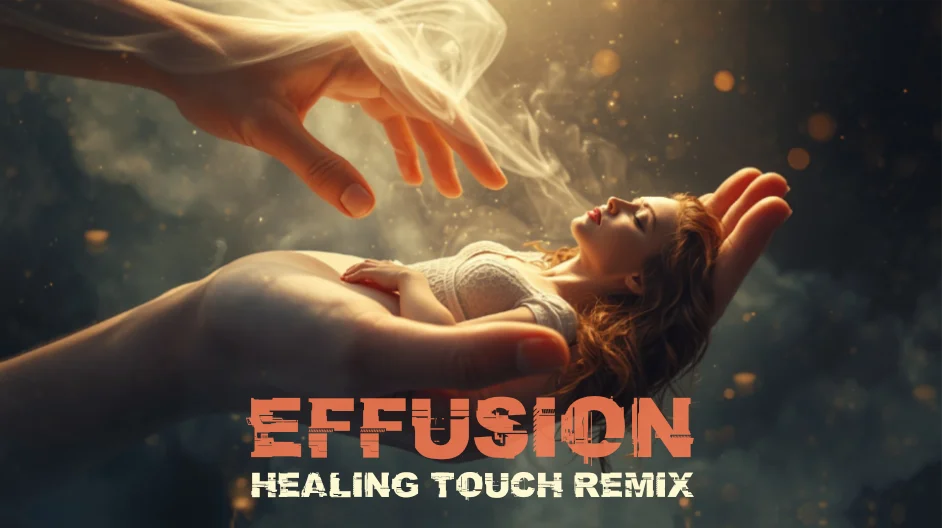
Some things cannot be automated. A kind word. A warm embrace. A healing touch.
Effusion – Healing Touch Remix, featuring Tamar (Clean)
But Who Gets to Decide Who Is “Real”?
Here is where things become complicated.
Spotify isn’t relying exclusively on artists to identify themselves.
Artists can voluntarily disclose that their profile represents an AI Persona through Spotify for Artists.
But Spotify will also review profiles itself, using human reviewers and AI investigative tools to identify public identities that appear to be photorealistic AI-generated personas. Spotify says it will initially focus on artists that have reached defined audience thresholds so the system covers the profiles most listeners encounter.
If Spotify applies the badge, the artist will be notified and given an opportunity to self-disclose or appeal.
Eventually, listeners will also be able to report profiles they believe represent AI Personas.
That sounds reasonable.
But it introduces an enormous philosophical and practical question:
Who gets to define authenticity?
What happens when a real human artist uses an AI-generated photograph as a stage persona?
What about an anonymous electronic musician who never reveals their face?
What about an animated artist?
What about a virtual performer controlled by a human?
What about a fictional character whose music is written and performed by humans?
What about an artist who deliberately blurs the line between human and machine?
Music history has always played with fictional identities.
David Bowie created characters.
Gorillaz created animated identities.
Daft Punk hid their faces behind helmets.
Artists have been creating alter egos, masks, fictional biographies and theatrical personas for decades.
So the distinction cannot simply be:
real face = real artist.
The question is much deeper.
It is whether there is a human creative identity behind the artistic project—or whether the identity itself is being manufactured as a synthetic product.
And algorithms may have a difficult time understanding that difference.
Spotify Is Drawing a Line—But It Is Not Anti-AI
There is an interesting contradiction here.
Spotify is simultaneously becoming more aggressive about transparency around AI while embracing AI technology itself.
The company has introduced AI Credits, SongDNA, Verified by Spotify and Artist Profile Protection as part of what it calls its Artist Identity & Trust efforts. Spotify says hundreds of thousands of profiles have already been verified, while tens of thousands of AI credits are being submitted daily.
Spotify is also developing AI-powered music experiences and recently announced licensing agreements around AI-powered fan-made covers and remixes.
So the company’s position isn’t:
AI doesn’t belong in music.
It appears to be closer to:
AI belongs in music, but listeners should understand what—and who—they are engaging with.
That is a much more defensible position.
AI is becoming another instrument.
But an instrument and an identity aren’t the same thing.
And Spotify Isn’t Alone
The broader music industry is moving toward the same question from several directions.
Music Business Worldwide reports that the RIAA and IFPI proposed voluntary “AI-generated” and “AI-assisted” tags in July for recordings distributed on services including Spotify and Apple Music. Meanwhile, major and independent music companies proposed principles for determining whether AI-made recordings should qualify for official charts.
The European Union’s AI Act has also entered a new phase, with content-labeling rules taking effect August 2, including obligations concerning certain AI-generated or manipulated content.
And competing streaming services are approaching the problem differently.
Deezer has focused on detecting and labeling AI-generated tracks themselves. Music Business Worldwide reports that Deezer said fully AI-generated music accounted for more than half of its daily uploads in June, approaching 90,000 tracks per day. (Music Business Worldwide)
Spotify’s approach is different.
It is beginning with the identity.
That distinction could prove important.
The Coming Music Ecosystem May Have Three Categories
We may eventually arrive at something like this:
1. Human Artist
A real person or human creative team operating under an identifiable artistic identity.
2. Human Artist Using AI
A human creative project that uses AI as part of songwriting, production, vocals, mastering, artwork or other elements.
3. AI Persona
An artist identity that is itself generated or substantially represented by artificial intelligence.
The second category is likely to become enormous.
And that is precisely why we shouldn’t automatically treat all AI music as the same thing.
The future of music may not be:
Human vs. AI.
It may instead be:
Human creativity + AI tools vs. synthetic identities vs. human creativity without AI.
Those categories can coexist.
The industry now needs a trustworthy way to tell listeners which is which.
But There Is a Bigger Question
Spotify says its programming is focused on “elevating music from authentic artists building careers in music.”
That sounds almost obvious.
But think about what Spotify is actually saying.
For decades, the music business decided who got heard through human institutions:
Record labels.
Radio programmers.
Editors.
Music journalists.
Promoters.
Retailers.
Now much of discovery is mediated by algorithms.
And the algorithm doesn’t necessarily care whether an artist has spent ten years developing their craft.
It cares about signals.
Engagement.
Listening behavior.
Retention.
Skip rates.
Popularity.
Similarity.
Momentum.
AI changes the equation because it can potentially manufacture the inputs.
If synthetic artists can be generated faster than human audiences can consume music, the streaming ecosystem could become overwhelmed by an ocean of technically competent but culturally meaningless content.
Spotify itself says it is already tuning its algorithms to avoid spam, “slop,” and low-effort content. (Spotify)
That word—slop—may ultimately be more important than “AI.”
Because the problem isn’t necessarily artificial intelligence.
The problem is industrialized content without meaningful human demand.
What Spotify Gets Right
There is a lot to like about this move.
Transparency: listeners should know when an apparently human artist is actually synthetic.
Choice: people who want to explore AI Personas can still do so.
Protection for independent artists: synthetic identities shouldn’t automatically receive unlimited algorithmic amplification simply because they can produce content at scale.
AI neutrality: the policy doesn’t punish human artists merely for using AI creatively.
Appeals: artists can challenge Spotify’s determination.
Those are sensible principles.
But there is one thing Spotify—and the entire industry—must be extremely careful about.
Don’t confuse authenticity with aesthetics.
A human artist doesn’t have to look human.
They don’t have to use their legal name.
They don’t have to show their face.
They don’t have to reject AI.
They don’t have to fit an industry’s traditional definition of an artist.
Authenticity should mean something deeper than appearance.
The Risk of a New Gatekeeper
There is also a legitimate concern on the other side.
Spotify is becoming increasingly powerful in determining what qualifies as authentic, discoverable and recommendable.
That power needs accountability.
If an artist is incorrectly labeled an AI Persona, the consequences could be significant.
Reduced discovery can mean fewer streams.
Fewer streams can mean less income.
Less income can mean fewer resources to create.
For an independent musician, algorithmic invisibility can be devastating.
So Spotify’s appeal system cannot simply exist on paper.
It needs to be transparent, accessible and responsive.
And ideally, artists should understand why they were flagged.
Otherwise we risk replacing one opaque algorithmic problem with another.
The Artist of the Future May Not Be Entirely Human
Perhaps the most interesting possibility is that we’re asking the wrong question.
Instead of asking:
“Is this artist real?”
Maybe the future asks:
“What exactly is the human contribution behind this artist?”
A songwriter could work with an AI vocalist.
A producer could build an AI-generated band.
A human could create a fictional character whose music is produced with generative tools.
A virtual performer could have thousands of genuine human fans.
A human artist could use AI for almost every technical component of production while remaining the creative director behind the work.
Where does the artist end and the machine begin?
There may never be one universal answer.
And perhaps there shouldn’t be.
Music has always evolved by absorbing new technology.
The synthesizer didn’t eliminate musicians.
Drum machines didn’t eliminate drummers.
Sampling didn’t eliminate producers.
Digital recording didn’t eliminate studios.
Auto-Tune didn’t eliminate singers.
AI doesn’t necessarily have to eliminate artists.
But it can change the economics of who gets heard.
And that is the real battle.
Spotify’s AI Persona Badge May Be the Beginning, Not the End
Spotify is calling this an effort to build trust.
It is.
But it is also something bigger.
It is the first serious attempt by one of the world’s largest streaming platforms to distinguish between AI as a creative instrument and AI as an artist identity.
That distinction could become one of the foundational concepts of the next era of music.
The badge itself is small.
A little label next to an artist’s name.
But behind that label is an enormous question:
When anyone—or anything—can manufacture a convincing artist, what makes an artist an artist?
The answer cannot simply be that humans are better than machines.
Sometimes they won’t be.
The answer cannot be that AI doesn’t belong in music.
It already does.
And it cannot be that synthetic artists should simply disappear.
Listeners may genuinely want them.
The answer may instead be something much simpler:
Tell us what we’re listening to.
Let the listener decide.
Let the human artist compete on a level playing field.
Let AI creators participate without pretending to be something they aren’t.
And above all, don’t allow the algorithm to quietly decide that an infinite supply of synthetic identities is equivalent to a finite number of human creative lives.
Because if streaming is going to become the world’s jukebox, the first thing it owes us isn’t more music.
It’s knowing who—or what—is singing.
David Frein
Sources: Spotify, Music Business Worldwide and industry reporting. Spotify’s AI Persona policy is scheduled to begin appearing in mid-September 2026. (Spotify)
© 2026 Abet News. All rights reserved.
Related Posts

11 comments on Spotify Draws a New Line Between AI and Human Music
Muddy Waters 😏 The unfortunate reality is that AI music will be a natural part of life for the next generation.
It’s disheartening to see the state of the music industry. I genuinely hope it can be fixed.
Australia just banned fully AI generated songs from its music charts. I think all other countries should follow.
Spotify features AI designed gym workout playlists. I wonder if they are using AI generated music.
It’s a good start.
Overall, it seems like a strong move for transparency 👍
Do you think ten years from now, people will still log hours of daily practice to learn an instrument—even when AI can whip up a full song in seconds?
Is anyone else missing CDs? 😀
This article raises an excellent point. There’s a world of difference between using AI as a creative tool and letting it generate music outright. In the studio, artists might use AI to modify a singer’s voice, but at its core, it’s still a human performance. Great read—thanks for sharing.
Spotify is leading again 👍
Yes, with Spotify 100%👍👍
Search: Post title, topic
Apple TV+
JMI Construction
© Abet News
Posts
About
Contact
Login
Privacy Policy