The Fleet Loophole vs. The Disguise Test
Abet News | Tech News / Fact Check | November 21, 2026
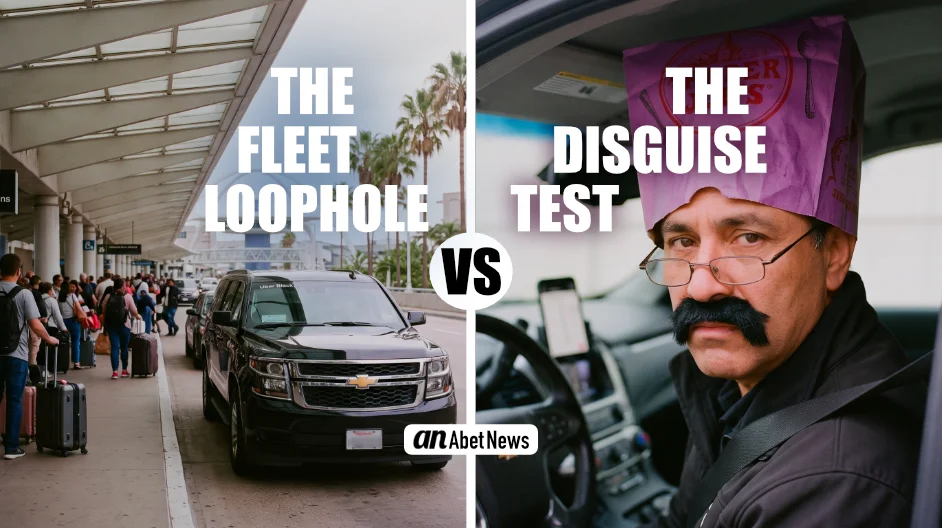
A recent ABC7 Eyewitness News report warned holiday travelers at Los Angeles International Airport (LAX) to watch out for rideshare drivers whose identities don’t match their app profiles. While passenger safety is critical, the broadcast left out major context—blending a 2025 commercial limousine incident with everyday UberX rides and offering inaccurate legal advice about checking a driver’s license.
An Abet News investigation—including a live test of Uber’s facial recognition software—reveals that the real story isn’t about independent UberX drivers sharing accounts. Instead, it exposes a loophole in commercial Uber Black fleets and raises troubling questions about how Uber uses automated selfie checks against drivers who decline low-paying trips.
Why LAX Mismatches Happen in Commercial Fleets—Not Owner-Operated UberX Cars
In framing Sarah Palmyra’s viral LAX incident as a broad warning about rideshare “app sharing,” ABC7 glossed over two critical facts: the incident took place more than a year earlier, in July 2025, and Palmyra had ordered an Uber Black SUV.
That distinction matters. Unlike standard UberX drivers—who typically own or personally lease their vehicles, carry personal rideshare endorsements, and guard their cars and accounts as their primary livelihood—Uber Black and Black SUV vehicles in California operate under commercial livery rules. Many are owned by third-party fleet companies that hold commercial Transportation Charter-Party Carrier (TCP) permits and collect trip payouts directly from Uber.
While Uber requires every fleet driver to pass a background check and link their own individual driver profile to the company’s vehicle, commercial fleet setups create an obvious operational loophole: a fleet operator can leave a single phone logged into an approved driver profile inside a shared SUV and hand the keys to an unvetted driver during a shift change. Because Uber Black vehicles pick up directly at LAX terminal curbsides—rather than the dedicated LAX-it lot used by UberX—airport police and state regulators routinely conduct curbside waybill and ID checks, catching commercial drivers whose licenses do not match the app.
A Verification System That Passes Disguises—But Flags Selective Drivers
To test how effectively Uber’s Real-Time ID Check actually stops unauthorized drivers, Abet News conducted a controlled experiment with an active UberX driver. Before triggering a routine in-app selfie verification, the driver altered his appearance using a fake mustache, glasses, and a bag placed over his head.
The facial recognition system approved the check immediately.
That result exposes a stark contradiction in Uber’s automated enforcement. If the software’s matching threshold is permissive enough to pass a heavily disguised driver—and fail to stop unvetted fleet drivers at LAX—it raises serious questions about why compliant, un-disguised UberX drivers are being hit with daily selfie prompts and permanent “account sharing” deactivations. According to driver testimonies submitted to Abet News, these verification loops frequently spike immediately after drivers exercise their right as independent contractors to decline low-paying trip offers.

Some things cannot be automated. A kind word. A warm embrace. A healing touch.
Effusion – Healing Touch Remix, featuring Tamar (Clean)
Fact-Check: Do Passengers Actually Have a Legal “Right” to Demand a Driver’s License?
Beyond omitting the commercial fleet context of Sarah Palmyra’s July 2025 Uber Black SUV ride, ABC7’s broadcast aired questionable legal advice for riders. During the segment, LAX police union representative Sgt. Mike Deer told viewers that passengers “have a right to look at their image and their driver’s license and make sure it matches,” adding that drivers can simply cover their home address.
Under California law, that is incorrect.
According to California Public Utilities Commission (CPUC General Order 157-E) regulations and the California Vehicle Code, rideshare and commercial livery drivers are legally required to present their physical driver’s license and electronic waybill only upon demand to law enforcement officers, airport enforcement personnel, or CPUC investigators—not to private passengers. Under state regulations, a passenger’s legal right to verification is satisfied through the app itself, which must display the driver’s first name, a photograph, and the vehicle’s make, model, and license plate number.
Why Drivers Refuse to Show Physical IDs to Strangers
Suggesting that passengers have a “right” to inspect a driver’s government ID ignores severe privacy and safety risks for drivers—even when an address is covered. A California driver’s license exposes a driver’s full legal name, date of birth, driver’s license number, physical descriptors, and signature.
Unlike commercial fleet vehicles registered to a corporate entity, most UberX vehicles are personally owned by the driver. Handing over or displaying a government ID to hundreds of strangers every month exposes independent drivers to identity theft, online harassment, and stalking—the exact reason Uber and Lyft intentionally withhold drivers’ last names in the app. While any passenger is free to ask to see an ID—and can choose not to get into the car if they feel uncomfortable—an UberX driver who declines to show their driver’s license to a passenger is protecting their personal security, not breaking the law or violating platform policy.
A Global Pattern of Automated Enforcement
The friction reported by UberX drivers mirrors a broader backlash against Uber’s algorithmic management worldwide. In August 2026, the Dutch Data Protection Authority fined Uber €825 million (nearly $966 million) for using automated systems to monitor driver behavior and deactivate accounts without meaningful human oversight—a penalty Uber is appealing. Weeks later, over 240,000 European and UK drivers launched a class-action lawsuit challenging the company’s algorithmic profiling and fare suppression.
Abet News has reached out to both Uber and ABC7 Los Angeles for comment regarding the timeline of the July 2025 clip, commercial fleet oversight at LAX, and the results of our Real-Time ID Check test, and will update this story if they respond.
ABC7: LAX police cite rideshare drivers whose app profiles didn’t match IDs.
Are you an Uber driver who was flagged or deactivated for alleged “account sharing” that never happened? Contact Abet News privately at hello@abetnews.com to share your documentation.
Petra Lugar
© 2026 Abet News. All rights reserved.
Related Posts

#ABC7, #AbetNews, #DriverRights, #GigEconomy, #LAX, #LosAngelesUberDrivers, #PetraLugar, #Rideshare, #RideshareDrivers, #RideshareIndustry, #Tech, #TechEthics, #TechIndustry, #TechNews, #Technology, #TechnologyAndHumanity, #TechnologyEthics, #TechPolicy, #TechRegulation, #TransportationTechnology, #TrustInTech, #Uber, #UberAlgorithmicPricing, #UberDriverPay, #UberDrivers, #UberDynamicPricing, #UberPricing
Apple TV+

JMI Construction