No Permission Required: How Rogue Uploaders Are Hijacking Apple Music Credits
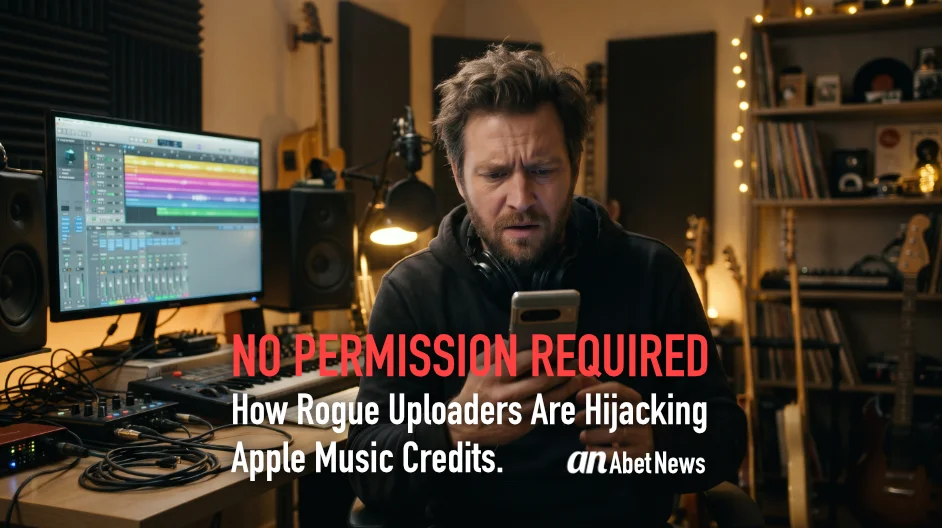
Abet News | Music Industry | November 24, 2026
For independent musicians, getting a release onto major streaming platforms like Apple Music and Spotify has never been easier. For a small fee, open-access digital distributors allow anyone to upload audio to global storefronts within days. Yet that same frictionless pipeline has created a growing vulnerability for established artists: metadata spoofing—commonly known as “feature hijacking.”
A look at the Apple Music catalog for electronic artist 5th Element illustrates how easily unauthorized credits can attach themselves to a legitimate artist’s profile—and why current storefront designs make it nearly impossible for fans or artists to see which distribution companies are letting it happen.
How “Feature Hijacking” Works
Feature hijacking occurs when an uploader lists a recognized artist as a featured collaborator (feat. [Artist]) or primary co-artist without permission, split sheets, or involvement. Because most open-access distributors do not verify featured artist consent before delivering metadata to streaming services, the false credit goes live automatically.
Once published, the streaming platform’s ingestion system routes the track directly onto the victim’s official artist page and triggers algorithmic recommendation engines, effectively siphoning visibility and confusing listeners.
On Apple Music, four distinct releases currently illustrate how wide-ranging this attribution problem can become for a single artist name:
• THE CHAMBERS: THE NEXT CHAPTER: 17 (feat. 5th Element & R.C Junior) — Released October 17, 2025, by CMORE SMD & ROG under the ℗ copyright line CHSMD RECORDS, attaching “feat. 5th Element” directly in the track title and artist credits.
• Real Talk (from Vengeance Is Rhyme) — Released September 27, 2025, by Qtalian (℗ 2025 Qtalian), listing “Qtalian & 5th Element” as joint track artists.
• Goodbye (feat. 5th Element) (from Overdue Not Overdone – O.n.O) — Released March 31, 2020, by Gordon SKL (℗ 2020 MajorMusiq Entertainment), similarly carrying a “feat. 5th Element” attribution.
• Hologramz — A 2014 album credited to “Hex One, 5th Element” (℗ 2014 Mic Theory Records), demonstrating how separate artists sharing a moniker or unverified joint credits can permanently entangle catalogs across decades.
Why Distributors Remain Invisible on Apple Music
When an artist discovers an unauthorized release on their page, the logical first step is to identify the distributor that delivered it and demand a takedown. On Apple Music, however, that delivery pipeline is hidden from public view.
1. Self-Reported Copyright Lines: Apple Music displays the ℗ phonographic copyright line typed in by the uploader—such as CHSMD RECORDS, Qtalian, or MajorMusiq Entertainment—rather than the backend aggregator that actually ingested and delivered the audio. If an uploader enters a custom label name or their own stage name, the distributor’s identity never appears on the storefront.
2. Storefront-First Design: Unlike YouTube’s auto-generated Topic uploads—which explicitly state “Provided to YouTube by [Distributor Name]” at the top of every video description—Apple Music treats distribution companies as invisible backend plumbing. Even track-level web links (…/song/…) omit the ℗ copyright footer altogether, forcing users to navigate to parent album pages or dig into mobile credit menus just to see a label name.
The Asymmetric Burden on Independent Musicians
While major record labels rely on direct enterprise feeds and automated content-matching tools to block unauthorized credits before release day, independent artists face a reactive game of whack-a-mole.
To clean up a single misattributed track on Apple Music, an independent artist must manually locate the release, copy the direct URLs, navigate to Apple Music for Artists Support, file an Artist Page Issue ticket, and wait for human moderation to unlink the track from their Artist ID—all while repeating the exact same manual process across Spotify, Amazon Music, and other digital storefronts.
A Call for Distributor Transparency
As open-access distribution continues to scale—fueled by rapid, low-cost uploads and AI-generated tracks—hiding the delivery pipeline only shields bad actors and lax aggregators from accountability.
Closing the feature-hijacking loophole requires two straightforward industry reforms:
• Mandatory Distributor Badges: Streaming services should publicly display the delivering distributor alongside the ℗copyright line on every release, making it immediately transparent which companies are profiting from unverified metadata.
• Opt-In Collaboration Approval: Just as social media platforms allow users to approve tags before a post appears on their profile, artist dashboards like Apple Music for Artists and Spotify for Artists should require a simple one-click approval before any third-party release can link to an artist’s ID.
Until platforms bring transparency to the distribution pipeline, independent artists will remain stuck policing their own profiles—paying the price in time and algorithmic reach for a system anyone can exploit for a few dollars.
Amy H.
© 2026 Abet News. All rights reserved.
Related Posts

#5thElement, #AbetNews, #AmyH, #AppleMusic, #Article, #DigitalRights, #DigitalRights2026, #IndependentArtists, #Industry, #IndustryImpact, #Metadata, #Music, #MusicDistribution, #MusicIndustry, #MusicIndustryAccountability, #MusicIndustryNews, #MusicStreaming, #MusicStreamingFraud, #StreamingIndustry, #StreamingPlatformScams, #Technology
Apple TV+
JMI Construction