
Why Should I Care? It’s Not My Problem
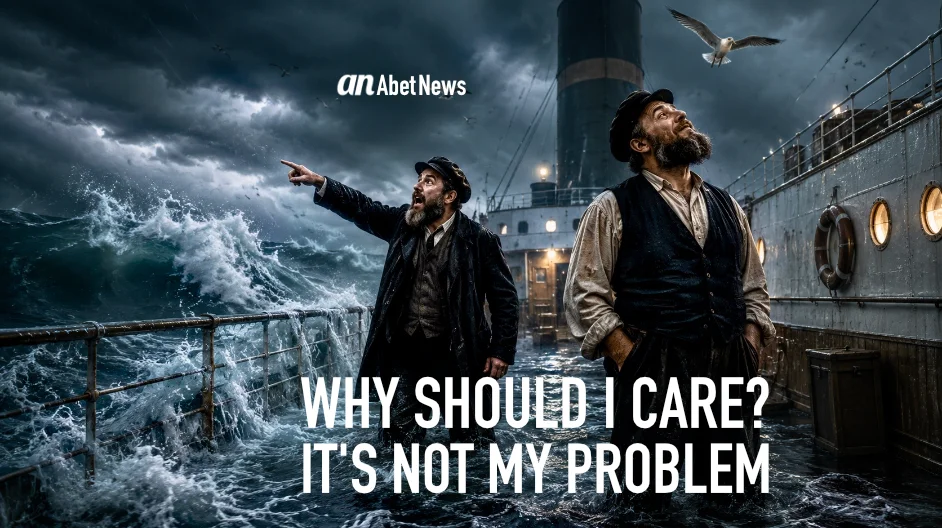
A century-old Yiddish joke may explain one of the greatest challenges of 2026.
ABET NEWS · OPINION · JULY 24, 2026
There is an old joke from Yiddish folklore that has survived for more than a hundred years. On the surface, it is amusing. Beneath the laughter, however, lies an uncomfortable truth about human nature.
The traditional version goes like this:
Two passengers are sharing a cabin aboard a transatlantic ocean liner when a violent storm strikes. One bursts into the room in a panic and shouts, “Moishe! Moishe! Wake up! The ship is sinking!”
Moishe rolls over, barely opens his eyes, and mutters, “Why should I care? It’s not my ship.”
The humor comes from its absurdity.
Moishe believes that because he does not own the ship, the disaster somehow does not concern him. He overlooks one crucial fact: he is still on board.
The joke originated in the Yiddish folklore of Eastern Europe during the late nineteenth or early twentieth century. Like much Yiddish humor, it uses exaggerated logic to reveal deeper truths about everyday life. Many of these stories emerged from communities that endured hardship, uncertainty, and poverty. Humor became a way to process difficult realities while exposing flawed ways of thinking.
More than a century later, the joke no longer feels like fiction.
It feels like a headline.
The Ship We All Share
The world of 2026 is more connected than at any point in history.
A cyberattack against one company can interrupt services across continents. A conflict thousands of miles away can affect fuel prices, food supplies, and financial markets. Artificial intelligence can transform industries almost overnight. Climate events, public health concerns, misinformation, and economic instability rarely remain confined to a single country or community.
Yet one response continues to echo through society:
“Why should I care? It’s not my problem.”
It appears whenever someone dismisses corruption because it happens elsewhere. It appears when online scams target someone else’s family. It appears when misinformation spreads because “it doesn’t affect me.” It appears when environmental damage, cybersecurity risks, or attacks on basic freedoms are viewed as someone else’s responsibility.
The irony is exactly the same as the old joke.
We are all passengers on the same ship.
Former CIA Officer Breaks Silence on Israel’s Influence.
The Cost of Looking Away
No single individual can solve every global problem.
But every person influences the environment around them.
Communities become stronger when neighbors look out for one another. Democracies depend on informed citizens. Digital security improves when individuals practice good habits. Public health depends on shared responsibility. Innovation flourishes when people choose collaboration over indifference.
Ignoring problems rarely makes them disappear.
Instead, small problems often become large crises because too many people assumed someone else would take care of them.
History repeatedly shows that societies rarely fail because everyone made the wrong decision. More often, they fail because too many people chose not to make any decision at all.

Some things cannot be automated. A kind word. A warm embrace. A healing touch.
Effusion – Healing Touch Remix, featuring Tamar (Clean)
Should We Do What We Can?
Perhaps that is the better question.
No one can fix everything.
Everyone can do something.
Progress is rarely built by grand gestures alone. More often, it is built by millions of ordinary people deciding that the condition of the ship matters because they are on it together.
As Mamdani Calls on Trump to Arrest Netanyahu, Genocide Scholar Decries Israel’s Ongoing Impunity
A Lesson That Never Sank
The brilliance of the old Yiddish joke is that it continues to make us laugh before it makes us think.
Its message has outlived steamships, world wars, and technological revolutions because human nature changes more slowly than technology.
The setting may have changed.
The ship has not.
Today, our ship is connected by fiber-optic cables, satellites, aircraft, supply chains, and digital networks. Every passenger’s actions ripple farther than ever before.
The question is no longer whether the ship belongs to us.
The question is whether we recognize that we are all aboard it.
“Our world is more connected than ever. We may not own every problem, but we all share its consequences. Choosing not to see them doesn’t keep us safe—it simply leaves us unprepared.” — Aeron Nersoya
When we’re all on the same ship, can anything truly be “someone else’s problem”?
Petra Lugar
© 2026 Abet News. All rights reserved
Related Posts










One comment on Why Should I Care? It’s Not My Problem
It’s difficult not to care; we are witnessing genocide almost live on our devices.